Banded Iron Formation
Banded iron formation (BIF) is a chemically precipitated sedimentary rock made of thin alternating layers of iron minerals, mainly hematite and magnetite, and silica-rich chert or jasper.
Banded iron formation (BIF) is a chemically precipitated sedimentary rock made of thin alternating layers of iron minerals, mainly hematite and magnetite, and silica-rich chert or jasper. Most BIFs formed in Precambrian oceans, chiefly between about 2.5 and 1.8 billion years ago, with older examples back to about 3.8 billion years.
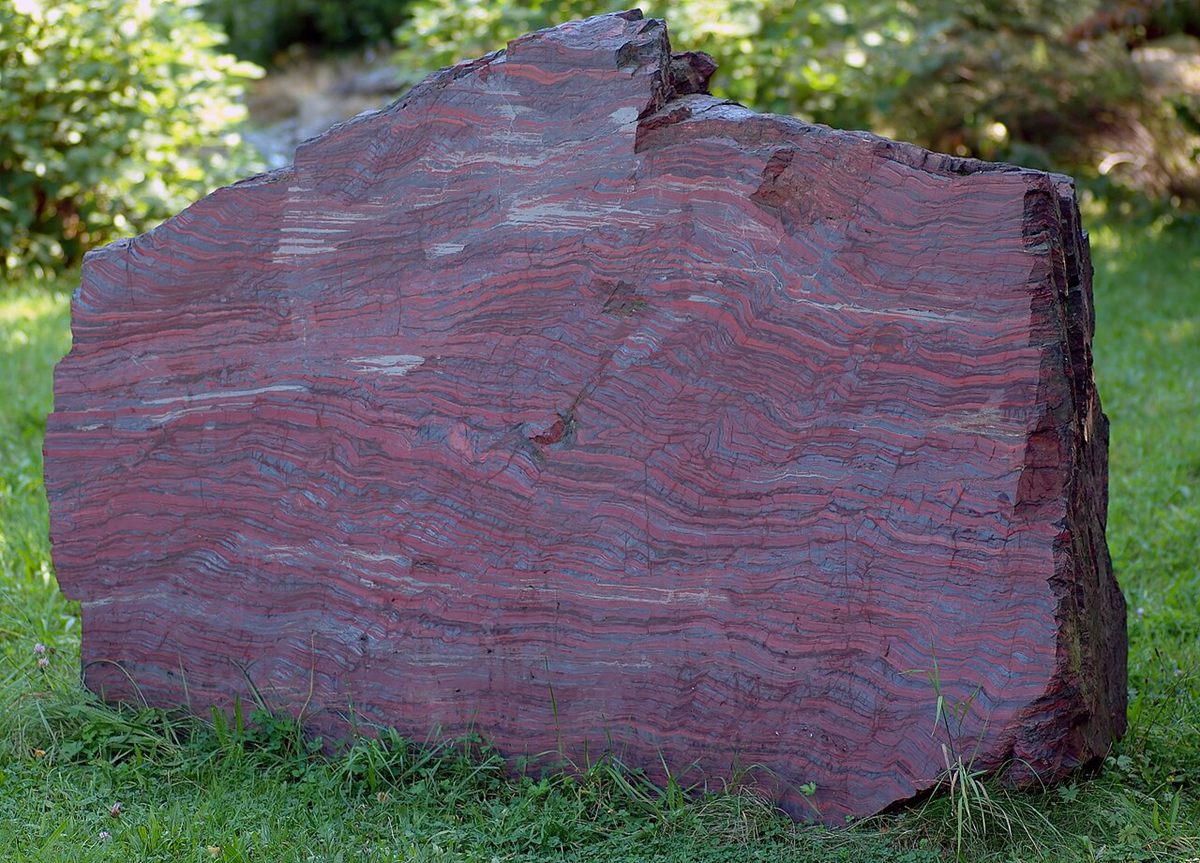
🪨 Geology Guide Specimen: Open Banded Iron Formation (BIF) in the CRV Science Rock & Mineral ID Guide to log the specimen, compare it with the other 6 subgroups of Sedimentary, and test your eye in LithoClade.
Iron in the Ancient Ocean: How Did BIF Form?
The early oceans were largely free of oxygen, so iron released by hydrothermal vents stayed dissolved as ferrous iron. Where it met oxygen made by cyanobacteria, or was oxidized by other microbes or by sunlight, it became insoluble ferric iron and sank as iron oxide, building layers on the sea floor. The rhythmic banding records pulses in oxidation, supply of iron or silica, and the details are still debated.
Rise of Oxygen: What Do BIFs Tell Us?
BIFs mark a time when the ocean could carry large amounts of dissolved iron and, in many views, a time of slowly rising oxygen. The great peak of deposition is close to the Great Oxidation Event, when oxygen began to accumulate in the air, and the rock is a lasting record of how photosynthesis changed the chemistry of the planet.
Iron Ore: Why Are BIFs Economically Vital?
Most of the world's iron ore comes from BIFs or from deposits that formed by enriching them. They are mined in the Hamersley Range of Western Australia, in Brazil's Iron Quadrangle and on the Mesabi Range of Minnesota, where lower-grade rock called taconite is processed into pellets for iron and steel making.
Banded Iron Formation at a Glance
| Property | Value |
|---|---|
| Type / variety | Precambrian Hematite–Magnetite–Jasper Strata |
| Composition | Alternating Metallic Hematite/Magnetite (Fe₂O₃/Fe₃O₄) & Red Jasper Chert (SiO₂) |
| Geology Guide group | Sedimentary Rocks (Clastic, Chemical & Biogenic) |
| Rock Classification | Siliceous, Iron & Organic |
| Mohs hardness | Mohs 5.5–7 |
| Texture / habit | Rhythmically laminated millimeter-to-centimeter red and silver-black bands |
| Density | 3.40–4.20 g/cm³ (heavy and often magnetic) |
| Lustre and cleavage | High-contrast crimson-red jasper layers and metallic silver-grey iron oxide bands |
| Geological setting | Archean and Paleoproterozoic oceans (3.8–1.8 billion years ago) |
| Diagnostic feature (Geology Guide) | Heavy, weakly magnetic Precambrian marine rock displaying striking alternating bands of crimson-red microcrystalline jasper and metallic silver-black magnetite and hematite. |
| Iron minerals | Hematite and magnetite |
| Silica layers | Chert or red jasper |
See Also
- Iron — the element at the heart of the rock
- Cyanobacteria — the oxygen producers behind the iron precipitation
- Hematite — the red iron oxide in the bands