Hematite
Hematite is iron(III) oxide, Fe₂O₃, with trigonal crystals and a hardness of 5.5 to 6.5. It is the world's main iron ore, and whatever its outside color, from steel-grey to red, it always leaves a red-brown streak.
Hematite is iron(III) oxide, Fe₂O₃, with trigonal crystals and a hardness of 5.5 to 6.5. It is the world's main iron ore, and whatever its outside color, from steel-grey to red, it always leaves a red-brown streak.
🪨 Geology Guide Specimen: Open Hematite (Kidney Ore / Specularite) in the CRV Science Rock & Mineral ID Guide to log the specimen, compare it with the other 8 mineral classes of Dana / Strunz Classes, and test your eye in LithoClade.
The Red Streak: How Do You Identify It?
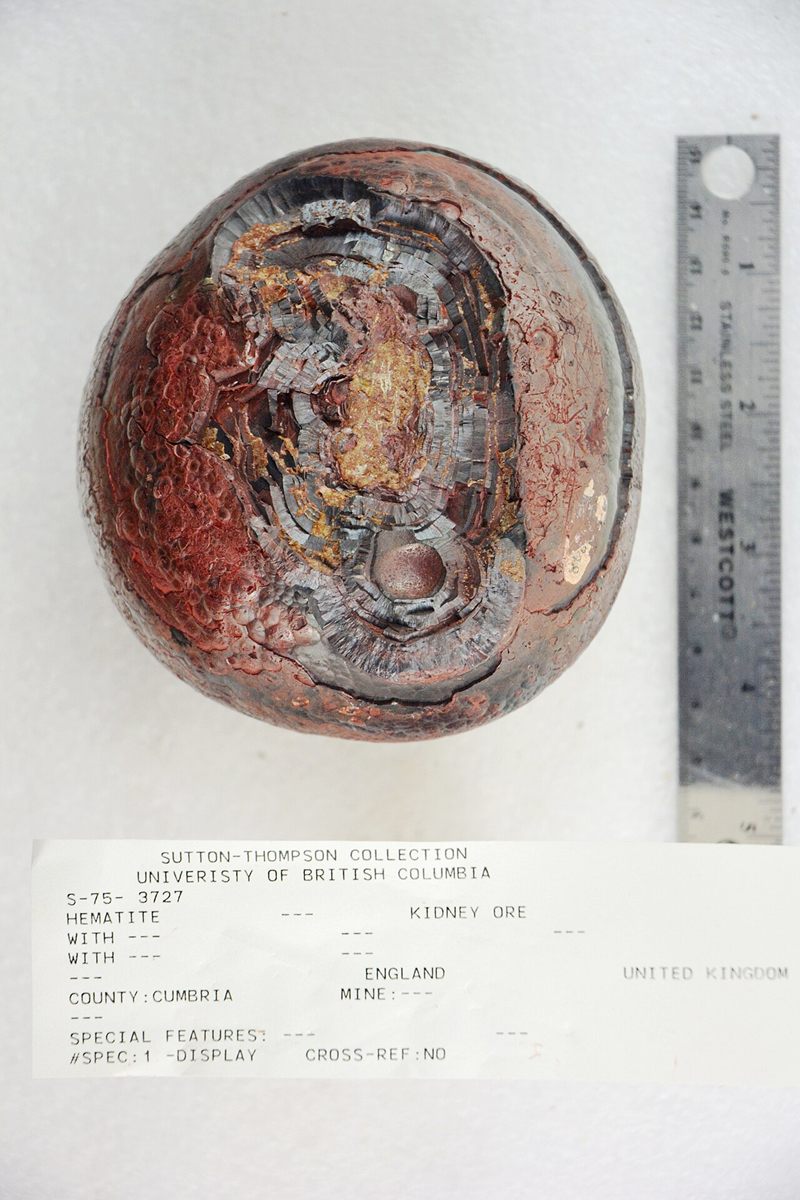
Rubbed on unglazed porcelain, hematite leaves a cherry-red to rust-brown streak, even when the specimen looks silvery and metallic. It can form mirror-bright plates (specularite), lobed masses called kidney ore, or earthy red ochre. The name comes from the Greek for "blood."
Iron Ore and Pigment: What Is It Used For?
About 70 percent iron by weight, hematite is mined mainly from banded iron formations and their enriched derivatives. Powdered hematite is the red pigment of ochre, used in cave paintings and later as paint. See iron.
Mars and Red Beds: Where Else Does Hematite Occur?
Hematite colors red beds, sedimentary rocks stained by oxidized iron. NASA's Opportunity rover found small hematite concretions, nicknamed blueberries, in rocks at Meridiani Planum on Mars, which showed that water once soaked those rocks. Compare the black, magnetic magnetite.
Hematite at a Glance
| Property | Value |
|---|---|
| Type / variety | Fe₂O₃ • Trigonal Iron Oxide |
| Composition | Fe₂O₃ (69.9 wt% Iron) |
| Geology Guide group | Minerals (8 Major Chemical Groups) |
| Mineral Group | Oxides & Hydroxides |
| Mohs hardness | Mohs 5.5–6.5 |
| Texture / habit | Botryoidal reniform ('kidney ore') masses, micaceous steel-grey plates, or earthy red |
| Density | 5.26 g/cm³ (heavy) |
| Lustre and cleavage | Metallic steel-grey to dull red; ALWAYS leaves a diagnostic cherry-red/rust-brown streak! |
| Geological setting | Banded iron formations, hydrothermal veins, and sedimentary red-bed cements |
| Diagnostic feature (Geology Guide) | Heavy (density 5.26 g/cm³) mineral occurring either as mirror-bright steel-grey crystals or lobate 'kidney-shaped' masses, yet regardless of its exterior color it ALWAYS leaves a blood-red to rust-brown streak on porcelain. |
| Formula | Fe₂O₃ |
| Streak | Red-brown |
See Also
- Magnetite — the magnetic iron oxide
- Banded Iron Formation — the main source of hematite ore
- Iron — the element it is mined for