Basket Star
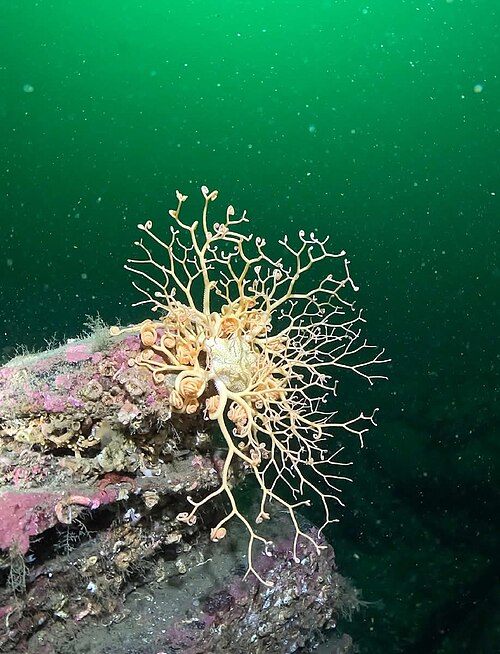
The basket star (Gorgonocephalus caputmedusae) is a large brittle star of the cold North Atlantic whose five arms branch repeatedly into thousands of fine tips. At night it climbs onto a high perch and spreads these arms like a net across the current.
The basket star (Gorgonocephalus caputmedusae) is a large brittle star of the cold North Atlantic whose five arms branch repeatedly into thousands of fine tips. At night it climbs onto a high perch and spreads these arms like a net across the current.
🧬 Field Guide Specimen: Open Basket Star in the CRV Science Field Guide to log the specimen, see its place among the Deuterostomia lineages in the Cladogram Explorer, and test your recall in the Red List conservation game.
Basket Star at a Glance
| Property | Value |
|---|---|
| Scientific name | Gorgonocephalus caputmedusae |
| Kingdom | Animalia |
| Phylum | Echinodermata |
| Class | Ophiuroidea |
| Order | Euryalida |
| Family | Gorgonocephalidae |
| Field Guide group | Deuterostomia: Echinodermata (Sea Stars & Allies) |
| Diagnostic feature (Field Guide) | Heavily branched serpentine arms radiating in a repeatedly branching, fractal-like pattern, hooklet-bearing arm segments to snag zooplankton. |
| Class | Ophiuroidea |
| Feeding | Suspension feeding with branched arms |
Taxonomy, Phylogenetics, and Evolutionary History
Gorgonocephalus caputmedusae—described by Carl Linnaeus in 1758 as Asterias caput-medusae, in allusion to the Gorgon Medusa—is the type species of Gorgonocephalus within the family Gorgonocephalidae, order Euryalida, and class Ophiuroidea. Together with unbranched brittle stars such as the Common Brittle Star (Ophiothrix fragilis), ophiuroids constitute the most speciose class of extant echinoderms (>2,100 species). Whereas asteroids (sea stars, such as the Common Starfish, Asterias rubens) possess broad arms containing digestive caeca, ophiuroids have a demarcated central disc from which solid-cored arms radiate.
Phylogenomic reconstructions divide Ophiuroidea into two superorders: Ophintegrida and Euryophiurida, which contains the orders Ophiurida and Euryalida (snake stars and basket stars). The family Gorgonocephalidae diverged during the Jurassic and Cretaceous periods, evolving dichotomous arm branching for suspension feeding in high-current shelf and bathyal habitats. In the cold Northeast Atlantic, G. caputmedusae inhabits Norwegian fjords, the Skagerrak, and the continental slope off Scotland, overlapping northward with Gorgonocephalus arcticus and Gorgonocephalus eucnemis.
Comparative Anatomy, Physiology, and Biomechanics
Dichotomous Fractal Branching and Streptospondylous Ossicles
A mature Gorgonocephalus caputmedusae has a pentagonal central disc up to 9 to 10 centimeters wide, covered by a leathery skin studded with calcite granules and radial shields. Five primary arms emerge from the disc and bifurcate; each branch divides dichotomously 10 to 16 times in a fractal geometry, producing thousands of prehensile terminal twigs and expanding the outstretched capture fan to 40 to 50 centimeters across.
Internally, each arm and sub-branch is supported by an axial series of calcareous vertebral ossicles precipitated as high-magnesium calcite (CaCO3 with 8% to 14% MgCO3) displaying a porous stereom microstructure. Unlike typical brittle stars whose zygospondylous vertebrae restrict dorso-ventral curling via interlocking pegs, euryalid basket stars possess streptospondylous (hourglass-shaped) vertebral articulations. This universal joint geometry permits the arms and branchlets to coil inward toward the oral surface in vertical, oblique, and horizontal planes without fracturing.
| Anatomical System | Structural Specialization | Biomechanical Role | Quantitative Parameter |
|---|---|---|---|
| Dichotomous arm fan | 5 primary arms with 10–16 sequential bifurcations | Maximizes filtration area in benthic currents | 3,000–5,000 branchlets; 40–50 cm span |
| Vertebral ossicles | Streptospondylous (saddle) high-Mg CaCO3 plates | Allows 360° spiral coiling of arms | Coils tips to <1 mm loop radius |
| Mutable collagen | Juxtaligamental control of intervertebral ligaments | Locks posture against flow with low ATP cost | Modulates stiffness 10- to 50-fold |
| Arm hooklets | Transverse girdles of recurved calcareous hooks | Snags swimming copepods and euphausiids | Hooks 100–350 μm with inner teeth |
Mutable Collagenous Tissue and Hooklet Prey Capture
Holding a 45-centimeter filtration fan perpendicular to bottom currents of 10 to 40 cm/s for hours would exhaust an animal if sustained by active muscle contraction. Gorgonocephalus caputmedusae overcomes this constraint using mutable collagenous tissue (MCT) within the intervertebral ligaments connecting adjacent arm ossicles. Innervated by juxtaligamental neurosecretory cells, MCT alters its tensile stiffness by over an order of magnitude within seconds via stiffening proteins (tensilin) and softening factors that modify cross-linking between collagen fibrils. Once the basket star unfurls its arms into the current, it locks its proximal ligaments into a rigid "catch" state with minimal O2 consumption while leaving the distal tendrils supple.
Along the distal arm branches, the skin bears transverse rings of microscopic calcareous hooklets armed with a terminal fang and inner teeth, interspersed with mucus glands. When a calanoid copepod, euphausiid krill (Meganyctiphanes norvegica), or chaetognath collides with the meshwork, the local branchlet coils reflexively in under 200 milliseconds, driving the recurved hooks into the crustacean's exoskeleton. Periodically, one major arm branch softens its proximal ligaments and curls downward toward the ventral mouth, where comb-like oral papillae strip the food boluses from the branchlets.
Trophic Ecology, Reproductive Life History, and Conservation
Between 15 and 1,200 meters depth in the Northeast Atlantic, Gorgonocephalus caputmedusae exhibits rheophilic habitat selection. Because water velocity near the seabed is slowed by boundary-layer friction, basket stars climb atop elevated biogenic perches—most frequently the cold-water octocorals Paragorgia arborea and Primnoa resedaeformis or deep-water sponges—clinging to the host with two or three basal arm branches while extending the remaining arms into the faster current above. Where daylight penetrates, the animal coils into a sphere by day and unfurls its net at dusk.
Gorgonocephalus caputmedusae is gonochoristic, releasing gametes from ventral bursal sacs in late summer. Lecithotrophic larvae settle onto soft corals (Alcyonium) before migrating onto adult conspecifics, where juveniles cling to the aboral disc. Regional assessments in Sweden and Norway highlight vulnerability to bottom-trawl fisheries that shear off gorgonian coral perches.
Frequently Asked Questions
How does a basket star eat the plankton it catches in its thousands of arm tips?
Unlike crinoids (feather stars), which transport trapped food particles down ciliated ambulacral grooves to the mouth while keeping their arms extended, Gorgonocephalus caputmedusae lacks open ciliated food grooves. Instead, its microscopic arm tips coil around macroscopic zooplankton such as copepods and krill, pinning them onto rows of calcareous hooks. Once a branch accumulates prey items, the arm bends inward to the underside of the central disc and pulls its branches across the serrated oral papillae of the mouth.
Can a basket star regenerate its branched arms if they are bitten by a fish?
Yes. Like other ophiuroids, Gorgonocephalus caputmedusae can autotomize (self-amputate) damaged arm segments by softening the mutable collagenous ligaments between vertebral ossicles when attacked by demersal fish or crabs. Provided the central disc and oral nerve ring remain intact, the basket star regenerates the missing arm and re-establishes its dichotomous branching pattern over subsequent months.
Why do basket stars frequently sit on top of deep-sea corals and sponges?
Water flowing over the seafloor experiences friction from rocks and sediment, creating a slow-moving boundary layer right at the bottom. By climbing 30 to 100 centimeters above the substrate onto tall octocorals such as Paragorgia arborea or Primnoa resedaeformis, the basket star elevates its filtration fan into faster, unobstructed currents that deliver a higher flux of drifting crustaceans per hour.
References
- Patent, D. H. (1970). Life history of the basket star, Gorgonocephalus eucnemis (Müller & Troschel) (Echinodermata; Ophiuroidea). Ophelia, 8(1), 145–160. https://doi.org/10.1080/00785326.1970.10429556
- Rosenberg, R., Dupont, S., Lundälv, T., Sköld, H. N., Norkko, A., Roth, J., Stach, T., & Thorndyke, M. (2005). Biology of the basket star Gorgonocephalus caputmedusae (L.). Marine Biology, 148(1), 43–50. https://doi.org/10.1007/s00227-005-0032-3
- O'Hara, T. D., Hugall, A. F., Thuy, B., Stöhr, S., & Martynov, A. V. (2017). Restructuring higher taxonomy using broad-scale phylogenomics: the living Ophiuroidea. Molecular Phylogenetics and Evolution, 107, 415–430. https://doi.org/10.1016/j.ympev.2016.12.006
- Wilkie, I. C. (2005). Mutable collagenous tissue: overview and biotechnological perspective. Progress in Molecular and Subcellular Biology, 39, 221–250. https://doi.org/10.1007/3-540-27683-1_10