Common Brittle Star
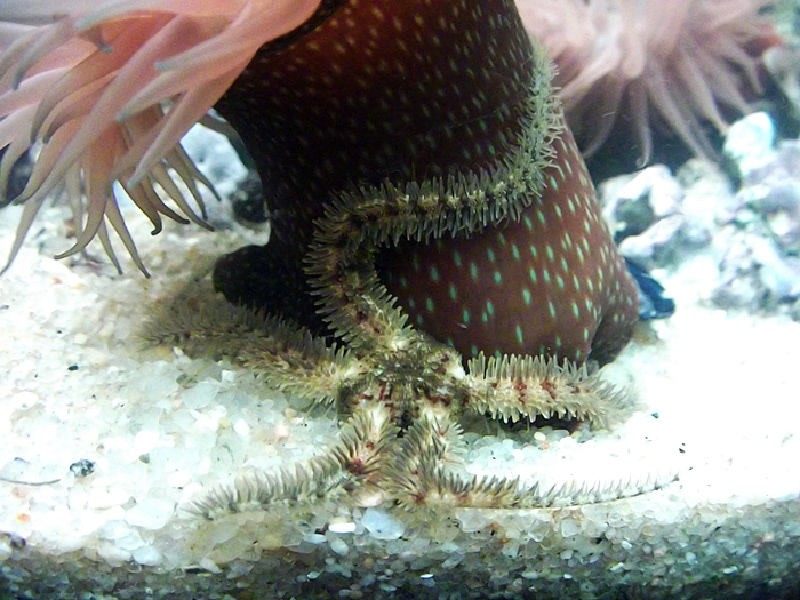
The common brittle star (Ophiothrix fragilis) is a small echinoderm of the northeastern Atlantic that forms dense beds on the seabed, sometimes with thousands of animals per square meter. Brittle stars have a central disc and five slender, flexible arms.
The common brittle star (Ophiothrix fragilis) is a small echinoderm of the northeastern Atlantic that forms dense beds on the seabed, sometimes with thousands of animals per square meter. Brittle stars have a central disc and five slender, flexible arms.
🧬 Field Guide Specimen: Open Common Brittle Star in the CRV Science Field Guide to log the specimen, see its place among the Deuterostomia lineages in the Cladogram Explorer, and test your recall in the Red List conservation game.
Snake-Like Arms: How Do They Move?
Unlike sea stars, brittle stars do not use suction tube feet to crawl. They move by rowing their arms across the sea floor, with the arm joints controlled by muscles. The arms are covered with spines and can curl around objects.
Feeding in Dense Beds
This species raises arms into the current and catches plankton and drifting particles with mucus on spines and tube feet. In dense aggregations, brittle stars can dominate a patch of seabed.
Breakable
The name comes from the ease with which the arms break off. A brittle star sheds an arm to escape a predator and regrows it. Arms contain calcite plates that act as a skeleton.
Common Brittle Star at a Glance
| Property | Value |
|---|---|
| Scientific name | Ophiothrix fragilis |
| Kingdom | Animalia |
| Phylum | Echinodermata |
| Class | Ophiuroidea |
| Order | Amphilepidida |
| Family | Ophiotrichidae |
| Field Guide group | Deuterostomia: Echinodermata (Sea Stars & Allies) |
| Diagnostic feature (Field Guide) | Distinctive circular central disc sharply demarcated from five long, slender, spiny serpentine arms used for rapid locomotion. |
| Class | Ophiuroidea |
| Density | Up to thousands per square meter |