Black Widow Spider
The black widow (Latrodectus mactans) is a venomous spider of North America, the female recognizable by her shiny black body and red hourglass marking on the underside. Her neurotoxic bite causes latrodectism, which is painful but rarely fatal.
The black widow (Latrodectus mactans) is a venomous spider of North America, the female recognizable by her shiny black body and red hourglass marking on the underside. Her neurotoxic bite causes latrodectism, which is painful but rarely fatal.
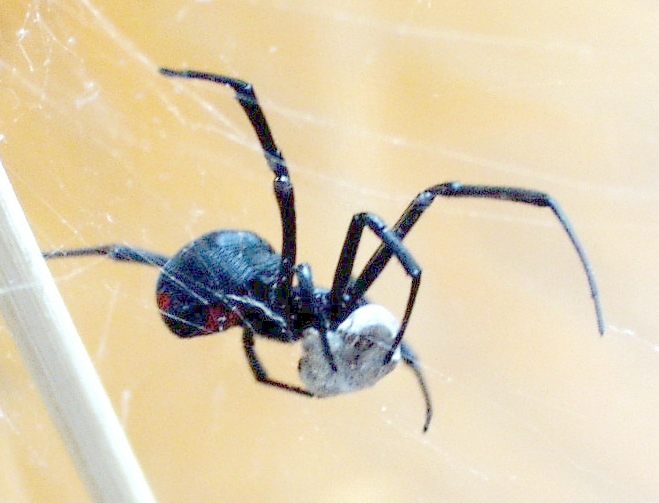
🧬 Field Guide Specimen: Open Black Widow Spider in the CRV Science Field Guide to log the specimen, see its place among the Ecdysozoa lineages in the Cladogram Explorer, and test your recall in the Red List conservation game.
A Venom That Acts on Nerve Endings: What Is Latrotoxin?
The main toxin, alpha-latrotoxin, binds to receptors on nerve terminals and inserts into the membrane, causing massive release of neurotransmitters. This produces severe pain, muscle cramps and sweating. The toxin has been an important tool for studying how nerve cells release neurotransmitters.
Webs and Lifestyle
Black widows spin messy, strong cobwebs in sheltered corners, and the female rarely leaves. The idea that females always eat their mates is an exaggeration; it happens in some cases but is not the rule.
Medical Care
Bites are treated with pain relief and, in severe cases, antivenom. Most healthy adults recover in a few days.
Black Widow Spider at a Glance
| Property | Value |
|---|---|
| Scientific name | Latrodectus mactans |
| Kingdom | Animalia |
| Phylum | Arthropoda |
| Subphylum | Chelicerata |
| Class | Arachnida |
| Order | Araneae |
| Field Guide group | Ecdysozoa: Arachnida (Spiders, Scorpions & Allies) |
| Diagnostic feature (Field Guide) | Globular black abdomen with ventral red hourglass mark, cheliceral fangs delivering neurotoxic latrotoxin, and abdominal silk spinnerets. |
| Main toxin | Alpha-latrotoxin |
| Order | Araneae |
See Also
- Cell membrane — a toxin that forms membrane pores
- Neuroscientist — neurotransmitter release