Branching Fire Coral
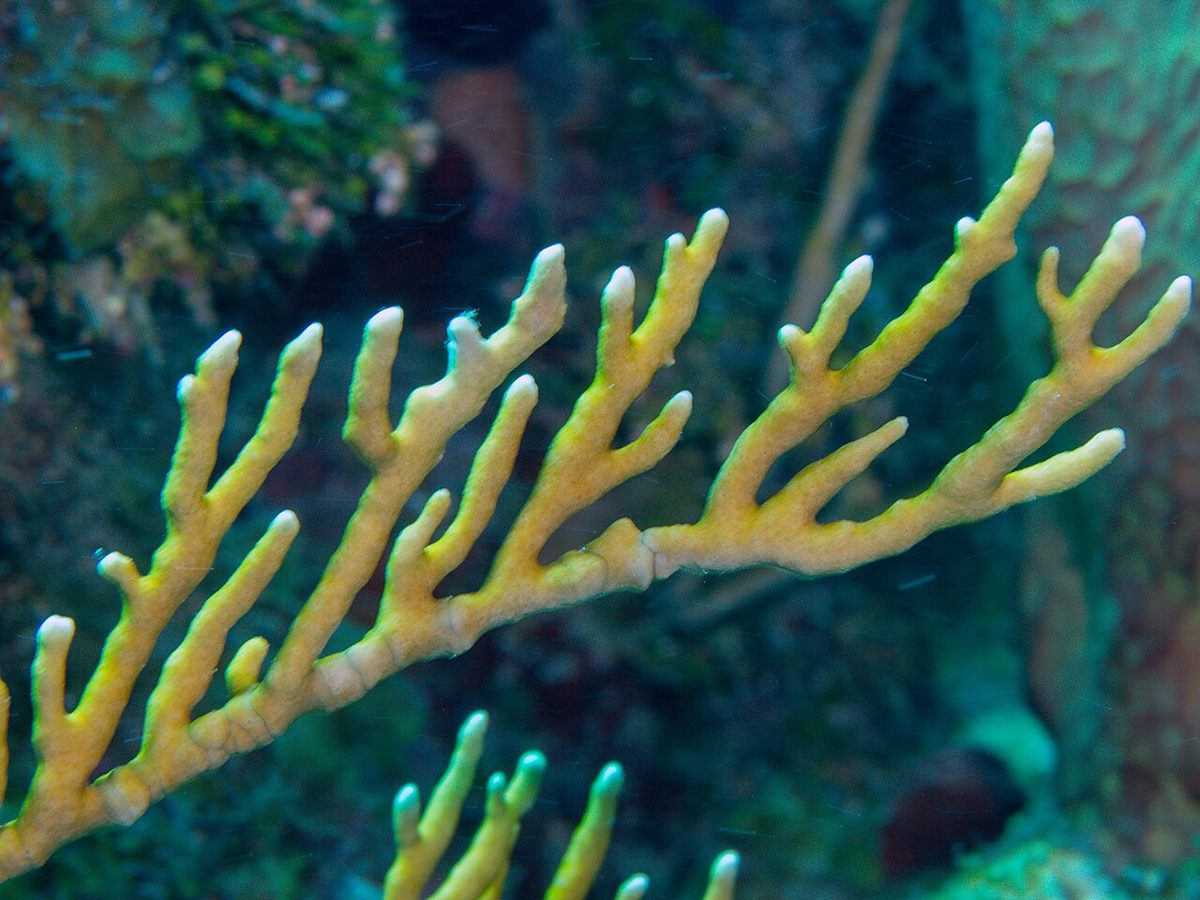
Branching fire coral (Millepora alcicornis) builds hard, branching skeletons on Caribbean reefs and looks like coral, but is a hydrozoan, more closely related to jellyfish. Brushing against it causes a burning sting.
Branching fire coral (Millepora alcicornis) builds hard, branching skeletons on Caribbean reefs and looks like coral, but is a hydrozoan, more closely related to jellyfish. Brushing against it causes a burning sting.
🧬 Field Guide Specimen: Open Branching Fire Coral in the CRV Science Field Guide to log the specimen, see its place among the Cnidaria+Ctenophora lineages in the Cladogram Explorer, and test your recall in the Red List conservation game.
Not a True Coral
Fire corals have tiny, hair-like polyps that emerge through pores in a calcium carbonate skeleton. They house symbiotic algae and add to the reef framework, but their anatomy differs from the stony corals (Scleractinia).
The Sting
Stinging cells on the polyps inject venom that causes pain and a rash. Divers are warned not to touch the golden-brown, lightly colored surfaces. See Portuguese Man o' War.
Heat-Sensitive
Like other symbiotic cnidarians, fire corals bleach in heat waves, and some populations have been decimated. See Coral bleaching.
Branching Fire Coral at a Glance
| Property | Value |
|---|---|
| Scientific name | Millepora alcicornis |
| Kingdom | Animalia |
| Phylum | Cnidaria |
| Class | Hydrozoa |
| Order | Anthoathecata |
| Family | Milleporidae |
| Field Guide group | Cnidaria + Ctenophora (Radiata & Jellies) |
| Diagnostic feature (Field Guide) | Mustard-yellow branching reef skeleton with pale tips, riddled with microscopic pores that house stinging polyps; burns on contact. |
| IUCN Red List status | Endangered (EN), assessed 2024 |
| Class | Hydrozoa |
| Skeleton | Calcium carbonate |
See Also
- Coral bleaching — heat stress
- Elkhorn Coral — a true coral