Portuguese Man o' War
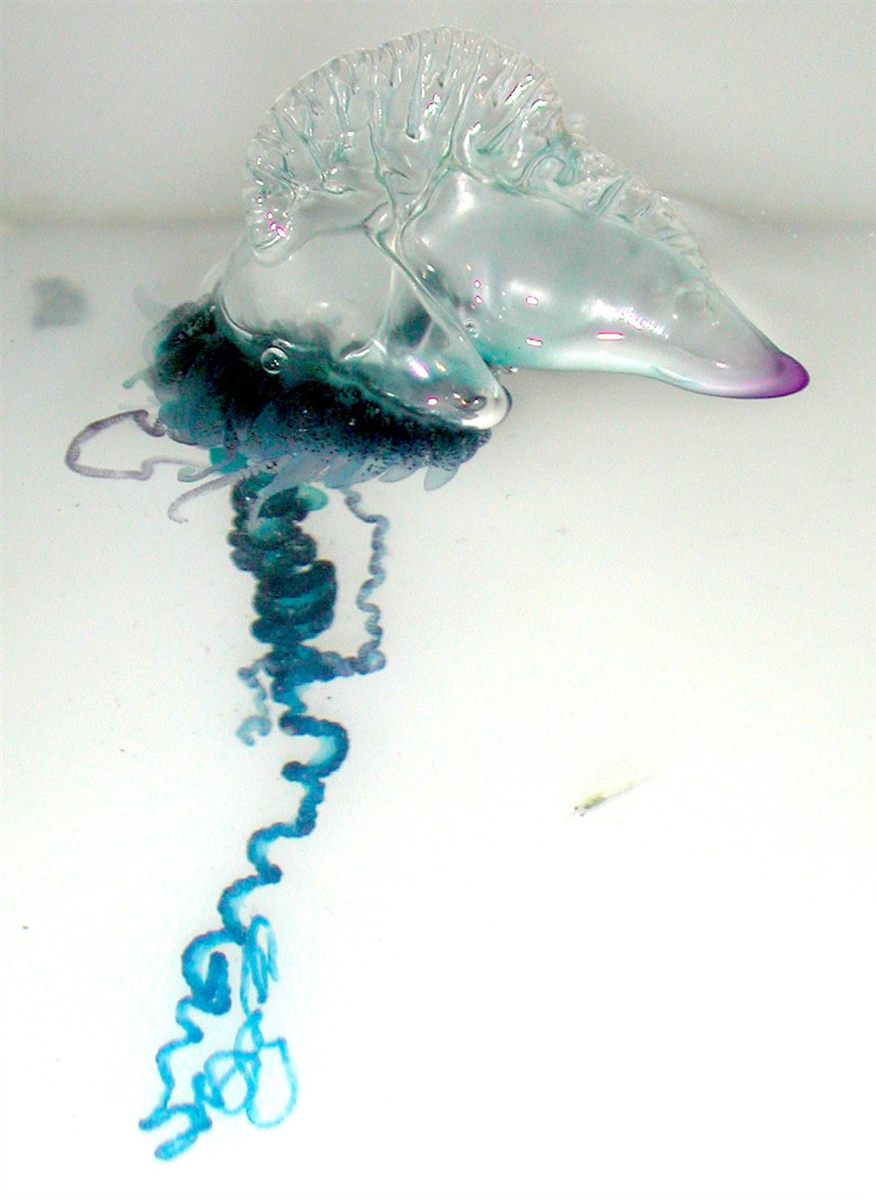
The Portuguese man o' war (Physalia physalis) drifts on the surface of warm oceans under a gas-filled float. It looks like a jellyfish but is a siphonophore, a colony of specialized, genetically identical individuals that cannot live alone.
The Portuguese man o' war (Physalia physalis) drifts on the surface of warm oceans under a gas-filled float. It looks like a jellyfish but is a siphonophore, a colony of specialized, genetically identical individuals that cannot live alone.
🧬 Field Guide Specimen: Open Portuguese Man o' War in the CRV Science Field Guide to log the specimen, see its place among the Cnidaria+Ctenophora lineages in the Cladogram Explorer, and test your recall in the Red List conservation game.
A Colony Disguised as an Animal
Different zooids in the colony form the float, the stinging tentacles, the digestive units and the reproductive parts. The tentacles, which may trail 10 meters or more, are armed with nematocysts that paralyze small fish. A sting is intensely painful to people.
Sailing: Left and Right-Handed
The float acts as a sail, and individuals are mirror-image forms that sail to different sides of the wind. This disperses populations so that not all are stranded on the same beach.
Predators and Beached Animals
Sea slugs such as Glaucus, loggerhead turtles and ocean sunfish eat man o' wars, and the slugs even store the stinging cells for their own defense. After storms, thousands wash ashore, still able to sting.
Portuguese Man o' War at a Glance
| Property | Value |
|---|---|
| Scientific name | Physalia physalis |
| Kingdom | Animalia |
| Phylum | Cnidaria |
| Class | Hydrozoa |
| Order | Siphonophorae |
| Field Guide group | Cnidaria + Ctenophora (Radiata & Jellies) |
| Diagnostic feature (Field Guide) | Gas-filled pneumatophore float, polymorphic specialized zooids (gastrozooids, dactylozooids, gonozooids). |
| Type | Siphonophore colony |
| Tentacle length | Often 10 meters or more |
See Also
- Scyphozoa propulsion — true jellyfish
- Sea surface temperature — warm water and drift