Caenorhabditis elegans
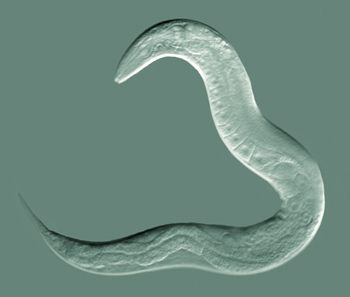
Caenorhabditis elegans is a transparent roundworm about a millimeter long that lives in soil and rotting fruit. It is one of the most thoroughly studied animals in biology, and work on it has led to several Nobel Prizes.
Caenorhabditis elegans is a transparent roundworm about a millimeter long that lives in soil and rotting fruit. It is one of the most thoroughly studied animals in biology, and work on it has led to several Nobel Prizes.
🧬 Field Guide Specimen: Open Roundworm in the CRV Science Field Guide to log the specimen, see its place among the Ecdysozoa lineages in the Cladogram Explorer, and test your recall in the Red List conservation game.
A Fully Mapped Animal
An adult hermaphrodite has exactly 959 body cells and 302 neurons, and every cell division from egg to adult has been traced. The complete wiring diagram of its nervous system, published in 1986, was the first connectome of any animal. In 1998 it became the first multicellular animal with a sequenced genome.
Nobel Prize Discoveries
Sydney Brenner chose the worm as a model; he, H. Robert Horvitz and John Sulston shared the 2002 Nobel Prize for genetic regulation of organ development and programmed cell death. Andrew Fire and Craig Mello received the 2006 Prize for RNA interference, and Martin Chalfie shared the 2008 Prize for green fluorescent protein, first used in worm neurons. See RNA interference.
Aging
Mutations in the insulin/IGF-1 receptor gene daf-2 can double the worm's lifespan, revealing that aging is under genetic control, a finding that launched a field of aging research.
Caenorhabditis elegans at a Glance
| Property | Value |
|---|---|
| Scientific name | Caenorhabditis elegans |
| Kingdom | Animalia |
| Phylum | Nematoda |
| Class | Chromadorea |
| Order | Rhabditida |
| Field Guide group | Ecdysozoa: Nematoda (Roundworms & Parasites) |
| Diagnostic feature (Field Guide) | One of biology's most critical genetic models; transparent body with exactly 959 somatic cells, invariant eutely, and mapped cell lineages. |
| Body cells | 959 (adult hermaphrodite) |
| Neurons | 302 |
See Also
- RNA interference — discovered in C. elegans
- Gene expression — control of development
- Genetics — model organisms