Capybara
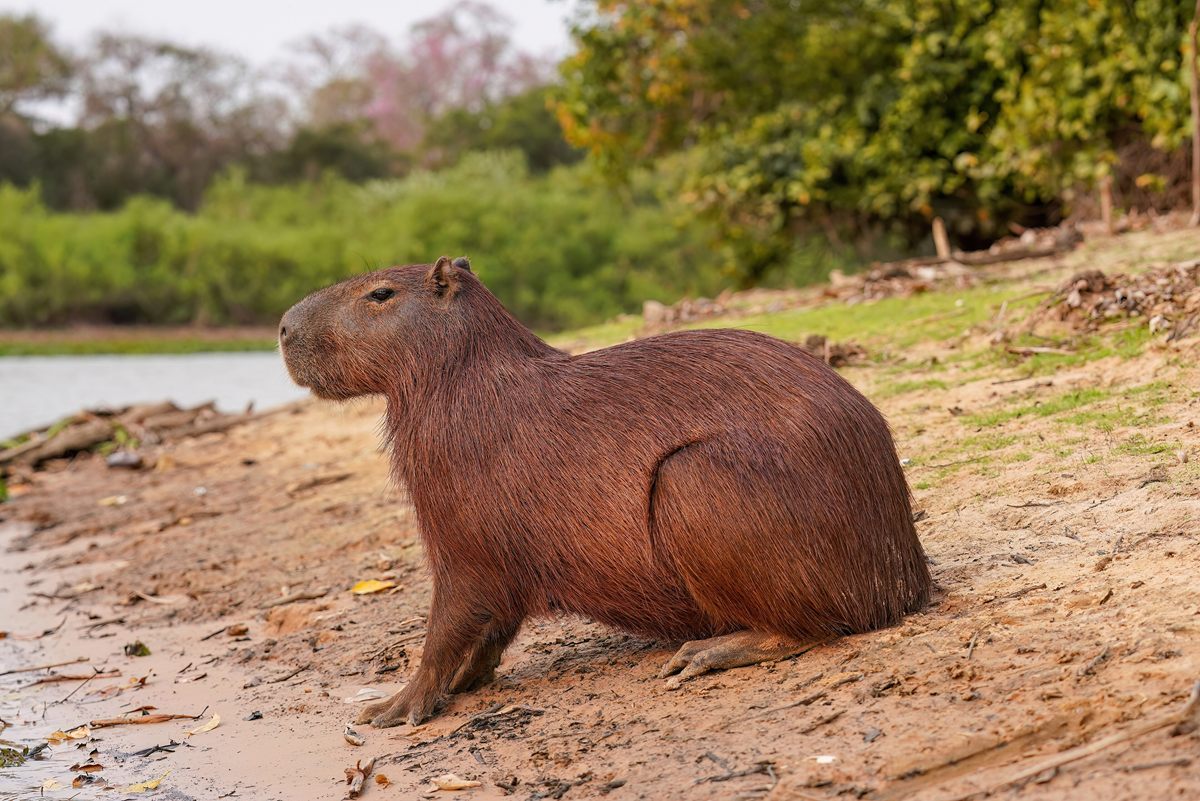
The capybara (Hydrochoerus hydrochaeris) is the largest living rodent, weighing up to about 65 kilograms, and lives in groups near water across South America east of the Andes. It is listed as Least Concern.
The capybara (Hydrochoerus hydrochaeris) is the largest living rodent, weighing up to about 65 kilograms, and lives in groups near water across South America east of the Andes. It is listed as Least Concern.
🧬 Field Guide Specimen: Open Capybara in the CRV Science Field Guide to log the specimen, see its place among the Mammals lineages in the Cladogram Explorer, and test your recall in the Red List conservation game.
A Semi-Aquatic Rodent: How Is It Built for Water?
Capybaras have partly webbed feet, and their eyes, ears and nostrils sit high on the head so they can float almost submerged. They spend the day in water or mud to stay cool and escape predators, and may dive and hide for several minutes.
Grazing and Social Groups
They graze on grasses and aquatic plants, and like rabbits they re-eat their feces to digest fiber thoroughly. Groups of ten to twenty animals, headed by a dominant male, may gather in much larger herds in the dry season. Predators include jaguars, caimans and anacondas.
Evolutionary Placement
Capybaras belong to Caviidae, the family that includes guinea pigs, within the New World hystricomorph rodents. A second, smaller species, the lesser capybara, lives in Panama and Colombia. Wetland loss is the main long-term threat.
Capybara at a Glance
| Property | Value |
|---|---|
| Scientific name | Hydrochoerus hydrochaeris |
| Kingdom | Animalia |
| Phylum | Chordata |
| Class | Mammalia |
| Order | Rodentia |
| Family | Caviidae |
| Field Guide group | Mammals: Eutheria (Placentals) |
| Diagnostic feature (Field Guide) | Semi-aquatic barrel-shaped body, partially webbed feet, continuously growing open-rooted hypsodont incisors. |
| IUCN Red List status | Least Concern (LC), assessed 2016 |
| Maximum weight | About 65 kilograms |