Colossal Squid
The colossal squid (Mesonychoteuthis hamiltoni) is a huge deep-sea squid of the Southern Ocean, the heaviest known squid and possibly the largest invertebrate.
The colossal squid (Mesonychoteuthis hamiltoni) is a huge deep-sea squid of the Southern Ocean, the heaviest known squid and possibly the largest invertebrate. Most of what is known comes from specimens recovered from the stomachs of sperm whales and from fishing catches.
🧬 Field Guide Specimen: Open Colossal Squid in the CRV Science Field Guide to log the specimen, see its place among the Lophotrochozoa lineages in the Cladogram Explorer, and test your recall in the Red List conservation game.
Rotating Hooks and the Largest Eyes
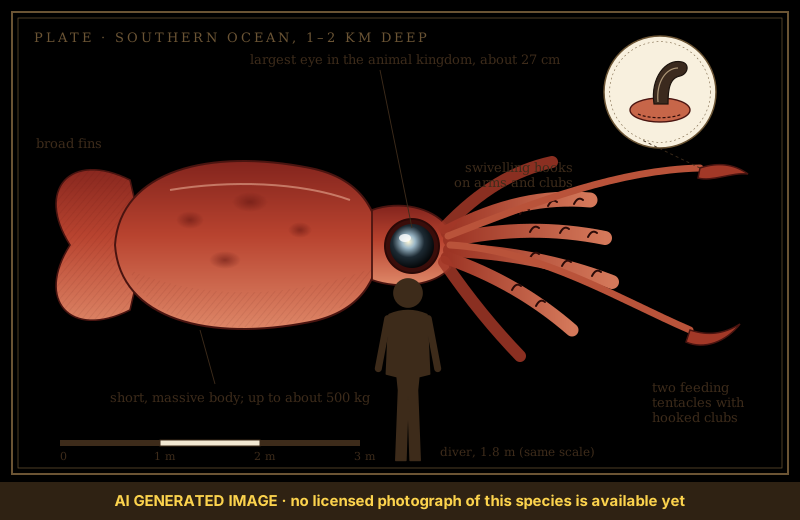
Unlike the giant squid, whose suckers are ringed with teeth, the colossal squid has swiveling hooks on its arms and tentacles. Its eyes, up to about 30 centimeters across, may be the largest of any animal and can detect the faint glow of bioluminescence in the dark water.
A Heavyweight Predator and Prey
A specimen caught in the Ross Sea in 2007 weighed nearly 500 kilograms. The squid feeds on fish such as Patagonian toothfish, and is itself preyed on by sperm whales and elephant seals. It was first described in 1925 from two tentacles found in a sperm whale.
Image Note
No licensed photograph of this species was available in the Field Guide, so the plate shown is clearly labeled as an AI-generated image.
Colossal Squid at a Glance
| Property | Value |
|---|---|
| Scientific name | Mesonychoteuthis hamiltoni |
| Kingdom | Animalia |
| Phylum | Mollusca |
| Class | Cephalopoda |
| Order | Oegopsida |
| Family | Cranchiidae |
| Field Guide group | Lophotrochozoa: Mollusca (Mollusks) |
| Diagnostic feature (Field Guide) | The heaviest invertebrate known, up to about 500 kg: a short, massive body, the largest eyes in the animal kingdom (about 27 cm), and swivelling hooks on its arms and tentacle clubs. |
| IUCN Red List status | Least Concern (LC), assessed 2014 |
| Class | Cephalopoda |
| Habitat | Deep Southern Ocean |
See Also
- Common Octopus — a shallow-water cephalopod
- Chambered Nautilus — a shelled cephalopod