Giant Isopod
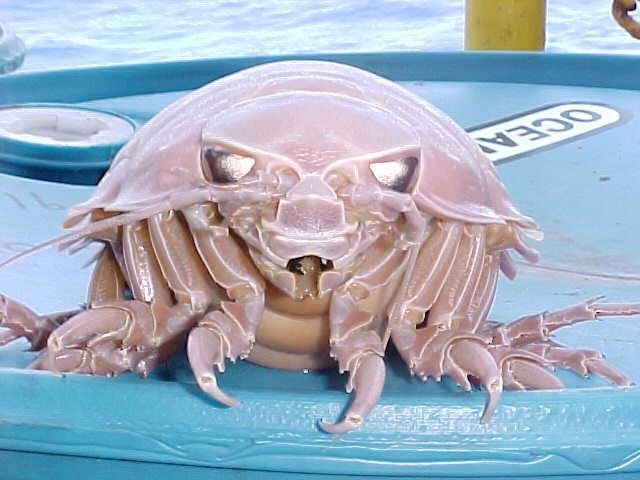
The giant isopod (Bathynomus giganteus) is a deep-sea crustacean up to about 40 centimeters long. It looks like an enormous pill bug and scavenges on carcasses on the cold seafloor.
The giant isopod (Bathynomus giganteus) is a deep-sea crustacean up to about 40 centimeters long. It looks like an enormous pill bug and scavenges on carcasses on the cold seafloor.
🧬 Field Guide Specimen: Open Giant Isopod in the CRV Science Field Guide to log the specimen, see its place among the Ecdysozoa lineages in the Cladogram Explorer, and test your recall in the Red List conservation game.
A Pill Bug the Size of a Football
Giant isopods are relatives of the common pill bug and the tongue-eating louse. They have a segmented, armored body, seven pairs of legs and large compound eyes with thousands of facets that are adapted for dim light. They can curl into a ball.
Fasting for Years
Food falls irregularly in the deep sea, and giant isopods can survive for very long periods without it. An individual in a Japanese aquarium reportedly went without food for more than four years.
Deep Sea Gigantism
Many deep-sea invertebrates are larger than their shallow-water relatives, a pattern called deep-sea gigantism. Possible reasons include the low temperature, scarce food and high pressure.
Giant Isopod at a Glance
| Property | Value |
|---|---|
| Scientific name | Bathynomus giganteus |
| Kingdom | Animalia |
| Phylum | Arthropoda |
| Class | Malacostraca |
| Order | Isopoda |
| Family | Cirolanidae |
| Field Guide group | Ecdysozoa: Mandibulata (Mandibulates) |
| Diagnostic feature (Field Guide) | Massive dorsoventrally flattened segmented crustacean up to 50 cm length, triangular reflective compound eyes, rolls into protective ball. |
| Order | Isopoda |
| Maximum length | About 40 centimeters |
See Also
- Common Pill Bug — a terrestrial relative
- Tongue-eating Louse — a parasitic isopod