Coconut Crab
The coconut crab (Birgus latro) is the largest land-living arthropod, with a leg span of up to about a meter and a weight of several kilograms.
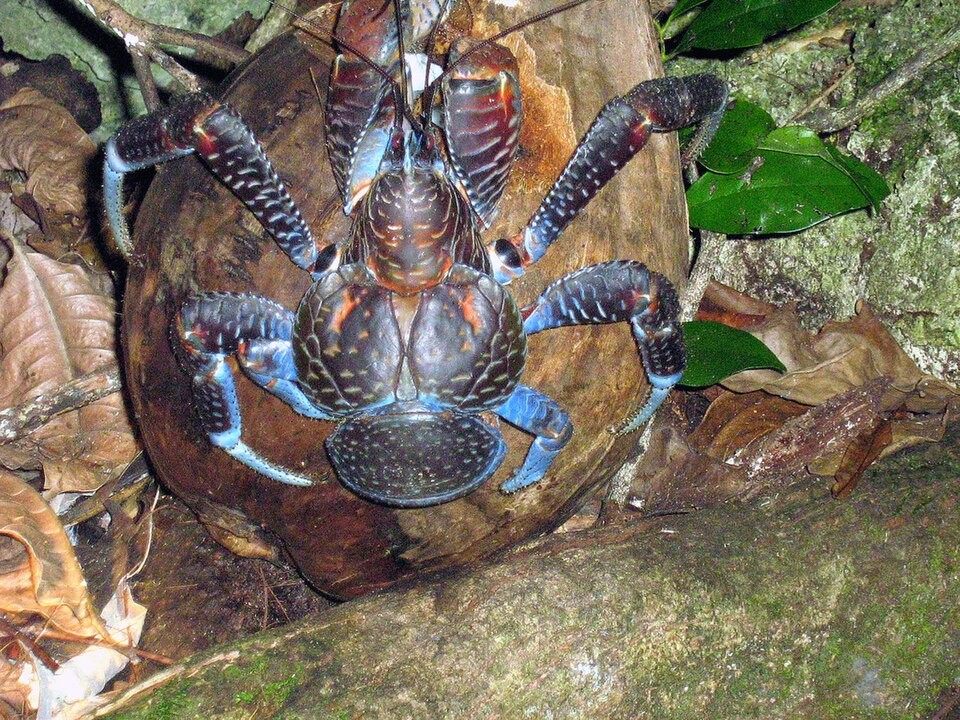
The coconut crab (Birgus latro) is the largest land-living arthropod, with a leg span of up to about a meter and a weight of several kilograms. It lives on islands of the Indian and Pacific oceans and is a giant hermit crab that no longer uses a shell as an adult.
🧬 Field Guide Specimen: Open Coconut Crab in the CRV Science Field Guide to log the specimen, see its place among the Ecdysozoa lineages in the Cladogram Explorer, and test your recall in the Red List conservation game.
A Crab That Breathes Air
Adults have lungs-like organs in the gill chamber and will drown if immersed in water for long. Females release their larvae into the sea, where they drift as plankton before the young crabs come ashore and use snail shells for a time.
Nutcracker
The crab climbs palms and uses its massive claws to open coconuts, sometimes after husking them. A measured pinch force of more than a thousand newtons is among the strongest of any land animal.
Island Pressures
Coconut crabs grow slowly and take decades to reach full size, so hunting for food and habitat loss have wiped them out from some islands. The species is a good example of island gigantism.
Coconut Crab at a Glance
| Property | Value |
|---|---|
| Scientific name | Birgus latro |
| Kingdom | Animalia |
| Phylum | Arthropoda |
| Class | Malacostraca |
| Order | Decapoda |
| Family | Coenobitidae |
| Field Guide group | Ecdysozoa: Mandibulata (Mandibulates) |
| Diagnostic feature (Field Guide) | Largest terrestrial arthropod on Earth (up to 4 kg), enormous crushing chelae generating 3,300 newtons of pinching force. |
| IUCN Red List status | Vulnerable (VU), assessed 2020 |
| Class | Malacostraca |
| Leg span | Up to about 1 meter |
See Also
- Giant Isopod — another giant crustacean
- Sea-level rise — a threat to island habitats