Yeti Crab
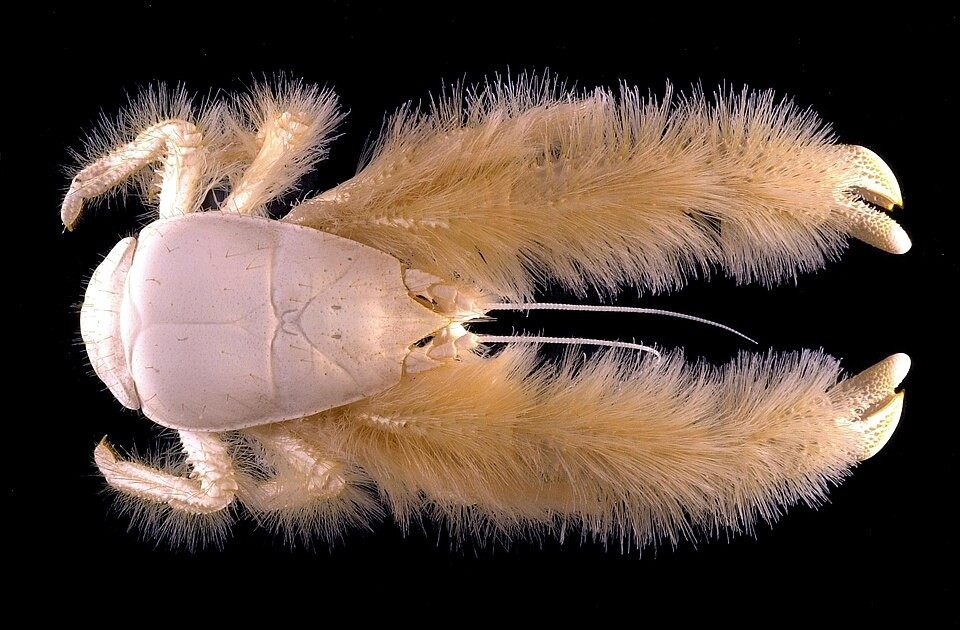
The yeti crab (Kiwa hirsuta) is a pale, hairy crab found in 2005 at hydrothermal vents on the Pacific-Antarctic Ridge south of Easter Island. Its claws are covered in dense bristles that carry colonies of bacteria.
The yeti crab (Kiwa hirsuta) is a pale, hairy crab found in 2005 at hydrothermal vents on the Pacific-Antarctic Ridge south of Easter Island. Its claws are covered in dense bristles that carry colonies of bacteria.
🧬 Field Guide Specimen: Open Yeti Crab in the CRV Science Field Guide to log the specimen, see its place among the Ecdysozoa lineages in the Cladogram Explorer, and test your recall in the Red List conservation game.
Farming Bacteria on Its Claws
The bristles (setae) host filamentous chemosynthetic bacteria. The crab waves its claws over the warm, mineral-rich vent fluid to feed the bacteria, then scrapes and eats them. See Giant Tube Worm.
A New Family
The animal was so different from other crabs that it was placed in a new family, Kiwaidae. It is more closely related to squat lobsters than to true crabs.
Life in the Dark
The crab is nearly blind, with eyes that lack pigment, and lives in cold water next to extremely hot vents. Very little is known about its biology.
Yeti Crab at a Glance
| Property | Value |
|---|---|
| Scientific name | Kiwa hirsuta |
| Kingdom | Animalia |
| Phylum | Arthropoda |
| Class | Malacostraca |
| Order | Decapoda |
| Family | Kiwaidae |
| Field Guide group | Ecdysozoa: Mandibulata (Mandibulates) |
| Diagnostic feature (Field Guide) | Ghostly white squashed carapace, pereiopods and chelae covered in dense silky hair-like setae farming filamentous thiotrophic bacteria. |
| IUCN Red List status | Not Evaluated (NE): no global IUCN assessment |
| Family | Kiwaidae |
| Habitat | Hydrothermal vents near Easter Island |
See Also
- Giant Tube Worm — another vent animal
- Coconut Crab — a very different anomuran