Red King Crab
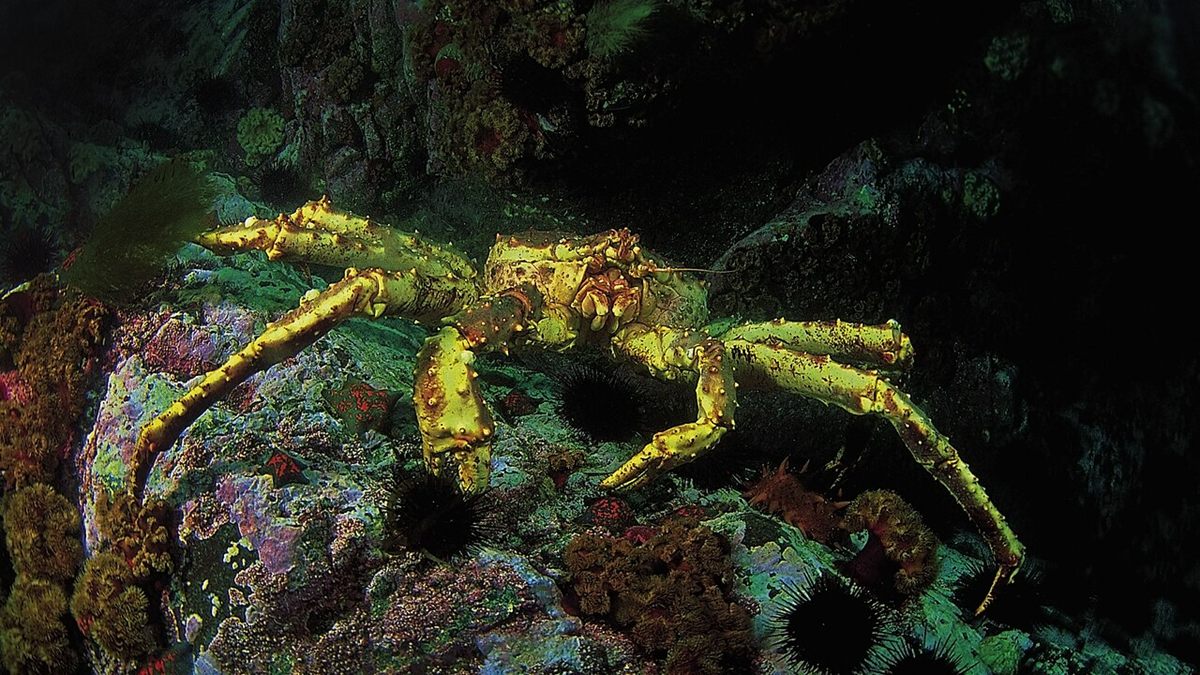
The red king crab (Paralithodes camtschaticus) is a giant crab of the North Pacific, with a leg span of up to about 1.8 meters. It supports a major fishery in Alaska and is an invader in the Barents Sea.
The red king crab (Paralithodes camtschaticus) is a giant crab of the North Pacific, with a leg span of up to about 1.8 meters. It supports a major fishery in Alaska and is an invader in the Barents Sea.
🧬 Field Guide Specimen: Open Red King Crab in the CRV Science Field Guide to log the specimen, see its place among the Ecdysozoa lineages in the Cladogram Explorer, and test your recall in the Red List conservation game.
A Crashing Alaskan Fishery
The Bering Sea king crab fishery boomed in the 1970s and collapsed in the early 1980s. Bristol Bay stocks have remained low, and the fishery was closed in 2021 and 2022 because of low numbers. Warming seas and changes in the ecosystem are suspected.
An Introduced Giant in Norway
Soviet scientists introduced the crab to the Barents Sea in the 1960s, and it spread along the coast of northern Norway. It eats bottom-living animals and has changed seabed communities, but is also now fished commercially.
Not a True Crab?
King crabs are anomurans, related to hermit crabs, and have a different leg count than true crabs: they appear to have three pairs of walking legs. See Coconut Crab.
Red King Crab at a Glance
| Property | Value |
|---|---|
| Scientific name | Paralithodes camtschaticus |
| Kingdom | Animalia |
| Phylum | Arthropoda |
| Class | Malacostraca |
| Order | Decapoda |
| Family | Lithodidae |
| Field Guide group | Ecdysozoa: Mandibulata (Mandibulates) |
| Diagnostic feature (Field Guide) | Huge spiny reddish crab of cold northern seas; legs span up to 1.8 meters and the last pair is tucked away under its shell. |
| IUCN Red List status | Not Evaluated (NE): no global IUCN assessment |
| Order | Decapoda (Anomura) |
| Leg span | Up to about 1.8 meters |
See Also
- Coconut Crab — another giant anomuran
- American Lobster — a fished decapod