Granodiorite
Granodiorite is a coarse-grained plutonic rock that looks like granite but contains more plagioclase than alkali feldspar.
Granodiorite is a coarse-grained plutonic rock that looks like granite but contains more plagioclase than alkali feldspar. It is the most abundant rock in many continental arc batholiths, and its average composition is close to that of the upper continental crust.
🪨 Geology Guide Specimen: Open Granodiorite in the CRV Science Rock & Mineral ID Guide to log the specimen, compare it with the other 7 subgroups of Igneous, and test your eye in LithoClade.
Plagioclase-Rich: How Is It Told Apart from Granite?
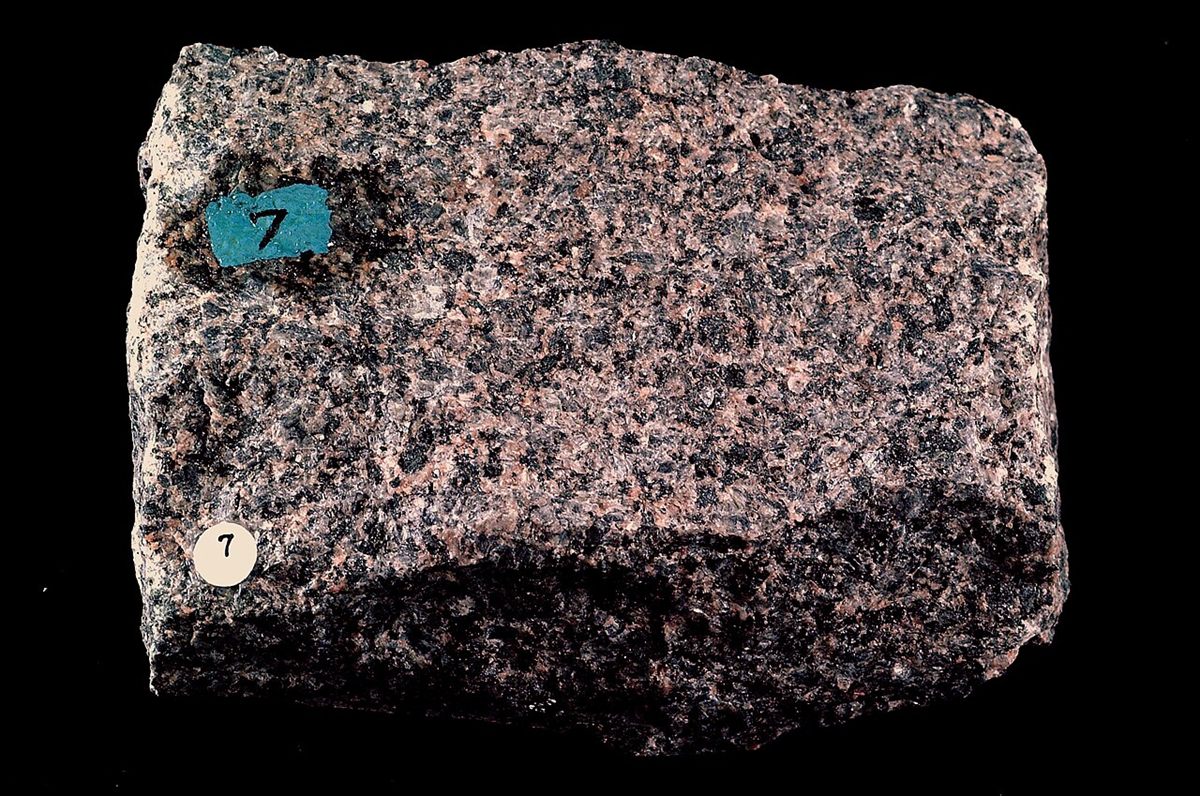
Both rocks need at least 20 percent quartz, but in granodiorite plagioclase makes up roughly 65 to 90 percent of the feldspar. The result is a lighter grey, speckled rock with abundant white feldspar, dark hornblende and biotite, and often small honey-colored crystals of titanite. Pink potassium feldspar is present but never dominant.
Arc Batholiths: Where Does It Form?
Water released from a subducting slab triggers melting in the mantle wedge, and the resulting magmas fractionate and mix with crust on their way up. The product builds batholiths along continental margins, including the Sierra Nevada, the Peninsular Ranges and the Andes. Many of Yosemite's cliffs and domes are cut in granodiorite and granite of the Sierra Nevada batholith.
Volcanic Counterpart: What Erupts from the Same Magma?
Magma of granodiorite composition that reaches the surface erupts as dacite or rhyolite, often as viscous lava domes or explosive pyroclastic flows. The plutonic and volcanic rocks are often found in the same arcs, representing the frozen magma chambers beneath active volcanoes.
Granodiorite at a Glance
| Property | Value |
|---|---|
| Type / variety | Plagioclase–Quartz–Biotite Granodiorite |
| Composition | Na-Plagioclase (45%) + Quartz (>20%) + K-Feldspar + Hornblende/Biotite |
| Geology Guide group | Igneous Rocks (Plutonic & Volcanic) |
| Rock Classification | Felsic Plutonic (Granitoids) |
| Mohs hardness | Mohs 6–7 |
| Texture / habit | Medium-to-coarse equigranular interlocking crystals |
| Density | 2.68–2.78 g/cm³ |
| Lustre and cleavage | Light grey speckled appearance with abundant white feldspar |
| Geological setting | Subduction-zone continental batholiths (e.g., Yosemite / Sierra Nevada) |
| Diagnostic feature (Geology Guide) | Coarse light-grey deep-seated rock containing over 20% glassy quartz, but with white sodium-calcium feldspar exceeding pink potassium feldspar by more than two-to-one alongside dark hornblende prisms. |
| Extrusive equivalent | Dacite |
| Typical setting | Subduction-zone batholiths |