Komatiite
Komatiite is an ultramafic volcanic rock with more than 18 weight percent magnesium oxide, found almost entirely in rocks older than about 2.5 billion years.
Komatiite is an ultramafic volcanic rock with more than 18 weight percent magnesium oxide, found almost entirely in rocks older than about 2.5 billion years. Its lavas were much hotter than any seen today, so they record how hot the early mantle was. It is named for the Komati River in South Africa.
🪨 Geology Guide Specimen: Open Komatiite in the CRV Science Rock & Mineral ID Guide to log the specimen, compare it with the other 7 subgroups of Igneous, and test your eye in LithoClade.
Super-Hot Lava: How Hot and How Fluid Was It?
Komatiite melts needed temperatures estimated at 1,500 to 1,600 degrees Celsius or more, far above modern basalt. At such temperatures the liquid was thin, with a viscosity closer to that of a light oil than of ordinary lava, and it could flow turbulently for long distances across the sea floor.
Spinifex Texture: What Are the Blades?
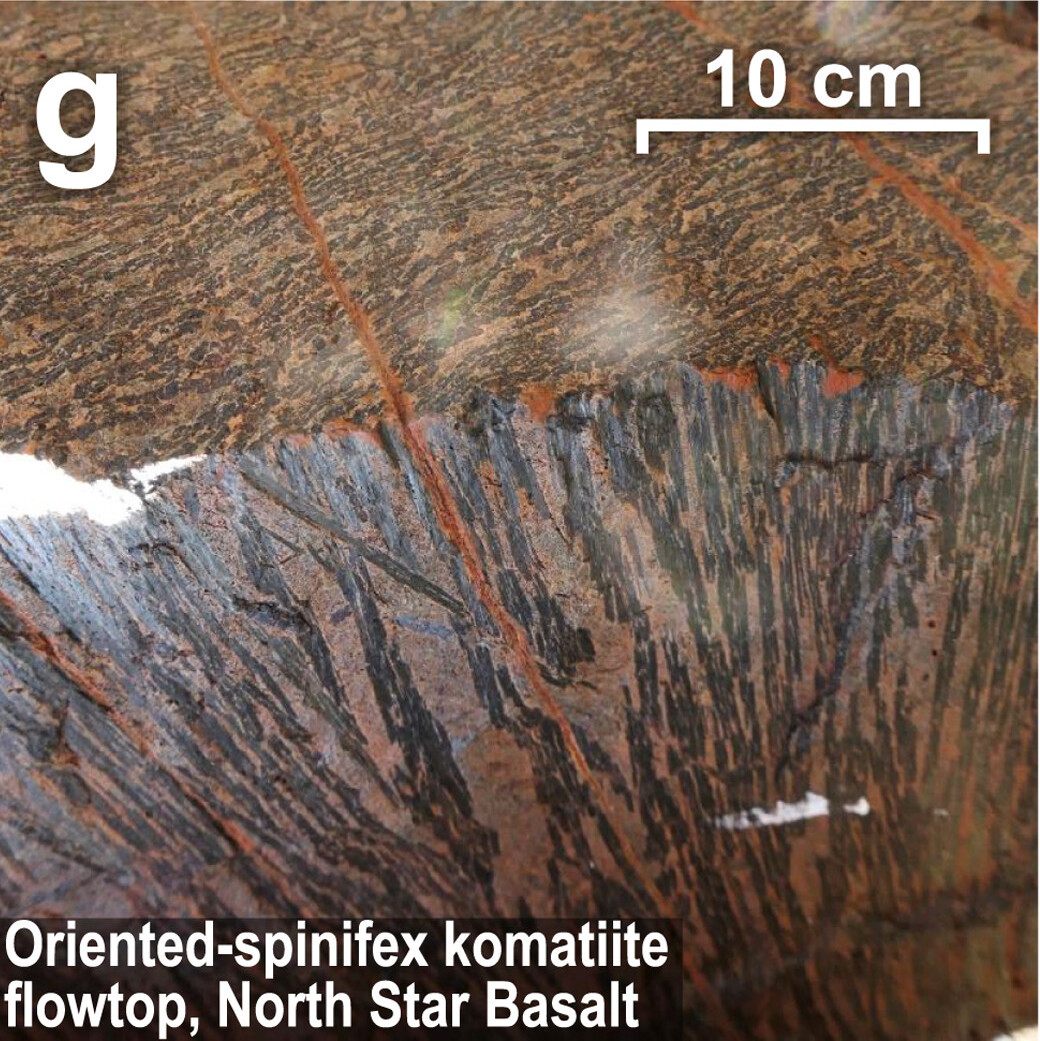
In the chilled upper parts of komatiite flows, long, skeletal crystals of olivine and pyroxene grew rapidly in a crisscrossing pattern. It resembles the spinifex grass of the Australian outback, giving the rock its characteristic spinifex texture.
Nickel and Early Earth: Why Does Komatiite Matter?
Archean komatiites host major nickel sulfide ores, such as those at Kambalda in Western Australia. They are very rare after the Archean, which supports the idea that the mantle cooled over time, and the few younger examples, such as those on Gorgona Island, Colombia, are interpreted as products of unusually hot mantle plumes.
Komatiite at a Glance
| Property | Value |
|---|---|
| Type / variety | Spinifex-Textured Archean Komatiite |
| Composition | <45% SiO₂, >18% MgO • Skeletal Bladed Olivine & Clinopyroxene |
| Geology Guide group | Igneous Rocks (Plutonic & Volcanic) |
| Rock Classification | Ultramafic & Mantle |
| Mohs hardness | Mohs 6–6.5 |
| Texture / habit | Spinifex texture (crisscrossing skeletal blades of olivine) |
| Density | 3.10–3.30 g/cm³ |
| Lustre and cleavage | Acicular radiating crystal blades resembling dry grass |
| Geological setting | Archean greenstone belts (>2.5 billion years ago) |
| Diagnostic feature (Geology Guide) | Ancient lava exhibiting a remarkable 'spinifex' fabric of long, crisscrossing skeletal blades of olivine that quenched from superheated (>1,600 °C), water-thin molten flows on the early Earth. |
| Named for | Komati River, South Africa |
| MgO content | More than 18 wt% |
See Also
- Peridotite — the mantle rock komatiite melts from
- Dunite — an olivine-rich rock related by composition
- Basalt — the modern mantle-derived lava