Mudstone
Mudstone is a fine-grained sedimentary rock of clay and silt that, unlike shale, breaks into blocky pieces rather than thin sheets. It is the most abundant sedimentary rock type among mudrocks.
Mudstone is a fine-grained sedimentary rock of clay and silt that, unlike shale, breaks into blocky pieces rather than thin sheets. It is the most abundant sedimentary rock type among mudrocks.
🪨 Geology Guide Specimen: Open Mudstone in the CRV Science Rock & Mineral ID Guide to log the specimen, compare it with the other 6 subgroups of Sedimentary, and test your eye in LithoClade.
Fabric: Why Doesn't Mudstone Split?
Shale splits because its clay flakes lie parallel. In mudstone, burrowing animals, roots and the way clay flocculates in water disturb that alignment, so the rock breaks in irregular blocks or nodules instead of sheets.
Color: Why Is Mudstone Red or Grey?
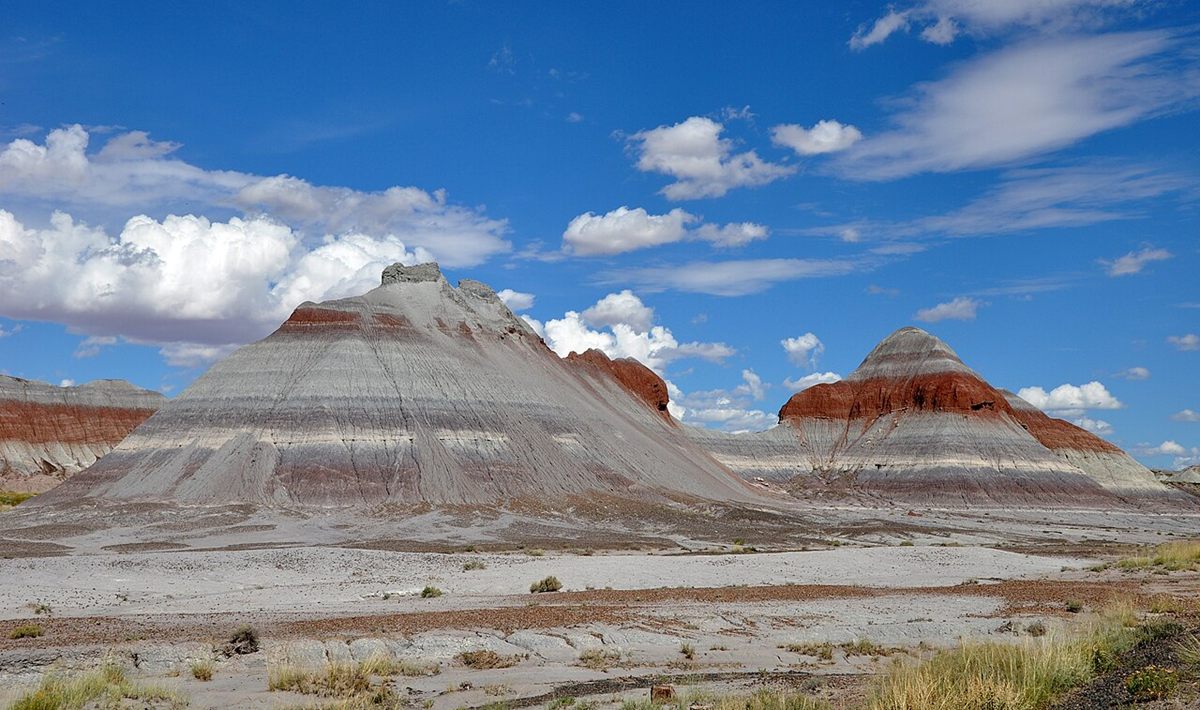
Oxidized iron in the form of hematite gives mudstones in well-aerated, often terrestrial settings their red and brown colors, as in the Chinle Formation of the Painted Desert. Where organic matter and low oxygen kept iron reduced, the rock is grey or black, and the color often records the environment of deposition.
Roles in the Earth System: Why Do Mudrocks Matter?
Mudstones make up most of the sedimentary record and store organic carbon. Because they are tight, they form seals above oil and gas reservoirs and barriers to groundwater flow, and their clay minerals come from the weathering of continents, as covered in silicate weathering.
Mudstone at a Glance
| Property | Value |
|---|---|
| Type / variety | Massive Non-Fissile Argillaceous Mudstone |
| Composition | Mixed Clay Minerals (<0.004 mm) + Fine Silt (0.004–0.0625 mm) + Iron Oxides |
| Geology Guide group | Sedimentary Rocks (Clastic, Chemical & Biogenic) |
| Rock Classification | Fine Clastic (Mudrocks & Shales) |
| Mohs hardness | Mohs 2.5–3.5 |
| Texture / habit | Smooth, creamy-feeling microscopic particles; breaks into blocky chunks |
| Density | 2.45–2.62 g/cm³ |
| Lustre and cleavage | Earthy matte red, brown, or grey with conchoidal/blocky fracture |
| Geological setting | Quiet lakes, lagoons, floodplains, and bioturbated marine floors |
| Diagnostic feature (Geology Guide) | Smooth, earthy red-brown or grey rock composed of microscopic silt and clay (<0.0625 mm) that breaks into blocky, irregular nodules rather than thin sheets because burrowing organisms randomized its clay flakes. |
| Grain size | Clay and silt, under 0.0625 mm |
| Fracture | Blocky rather than fissile |
See Also
- Siltstone — the coarser, gritty relative
- Black Shale — the fissile, organic-rich relative
- Silicate Weathering — the source of clay minerals