Black Shale
Black shale is a fine-grained, laminated mudrock rich in organic carbon, which gives it a dark color. It splits easily into thin sheets and forms in basins where oxygen is scarce and organic matter is preserved rather than eaten.
Black shale is a fine-grained, laminated mudrock rich in organic carbon, which gives it a dark color. It splits easily into thin sheets and forms in basins where oxygen is scarce and organic matter is preserved rather than eaten.
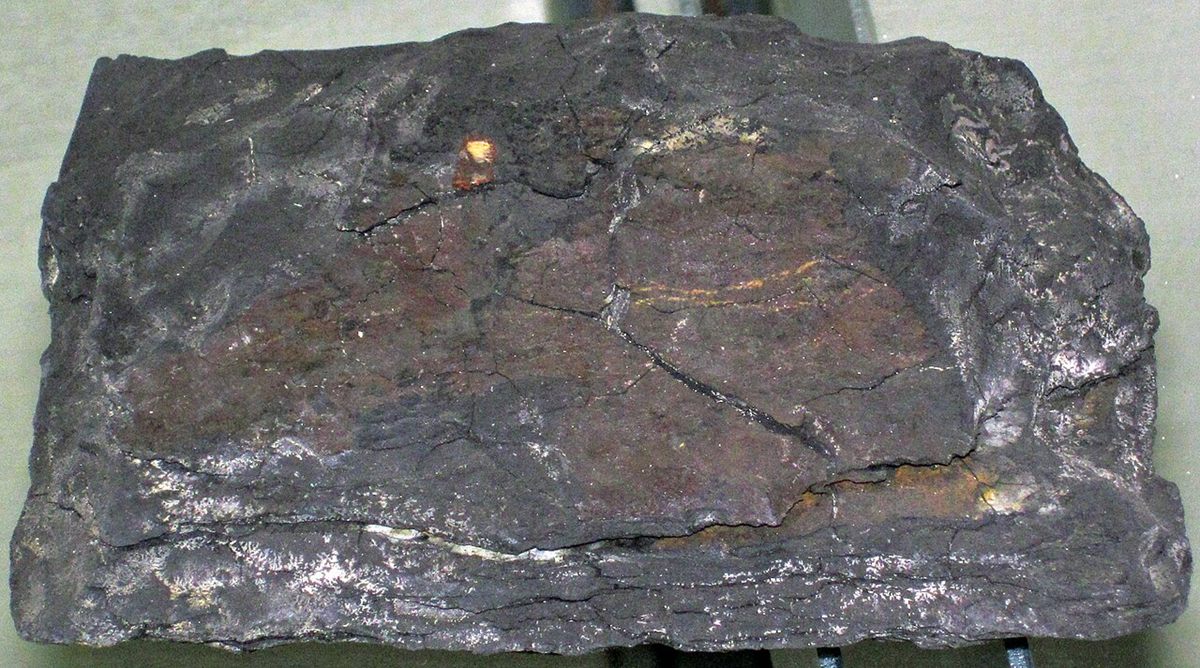
🪨 Geology Guide Specimen: Open Fissile Black Shale in the CRV Science Rock & Mineral ID Guide to log the specimen, compare it with the other 6 subgroups of Sedimentary, and test your eye in LithoClade.
Fissility: Why Does Shale Split?
Clay minerals are platy, and as muddy sediment compacts the flakes align parallel to the bedding. The result is a rock that breaks along paper-thin planes, a property called fissility. It is also soft, with a hardness of 2.5 to 3.5.
Anoxic Basins: How Does Organic Carbon Survive?
Organic matter from plankton normally decays quickly in oxygenated water. In stagnant or low-oxygen bottoms, decay is slow and carbon is buried with the mud, along with pyrite. Black shales also record events such as the Cretaceous ocean anoxic episodes, in which ocean deoxygenation was widespread.
Source Rock: Why Is Black Shale Economically Important?
Buried and heated, the organic matter generates oil and gas, so black shales are the source rock for much petroleum and the target of shale-gas production. They also trap metals and carry fossils such as graptolites, and they are a major part of the fossil fuel story.
Black Shale at a Glance
| Property | Value |
|---|---|
| Type / variety | Organic-Rich Laminated Argillaceous Shale |
| Composition | Illite/Kaolinite/Smectite Clays (<0.004 mm) + Organic Carbon (2–15%) + Pyrite |
| Geology Guide group | Sedimentary Rocks (Clastic, Chemical & Biogenic) |
| Rock Classification | Fine Clastic (Mudrocks & Shales) |
| Mohs hardness | Mohs 2.5–3.5 |
| Texture / habit | Microscopic clay particles splitting along paper-thin fissile laminae |
| Density | 2.35–2.60 g/cm³ |
| Lustre and cleavage | Dull charcoal-black platy sheets, often preserving graptolite or pyritized fossils |
| Geological setting | Deep stagnant anoxic marine basins and quiet offshore bottoms |
| Diagnostic feature (Geology Guide) | Charcoal-black, ultra-fine-grained rock (<0.004 mm particles) that splits effortlessly into paper-thin parallel sheets ('fissility') and smells faintly of petroleum or sulfur when struck. |
| Organic carbon | Commonly a few percent or more |
| Typical setting | Stagnant, low-oxygen basins |
See Also
- Ocean Deoxygenation — the condition that preserves organic matter
- Fossil Fuels — the energy resources that black shales help generate
- Mudstone — the non-fissile relative