Red Sea Urchin
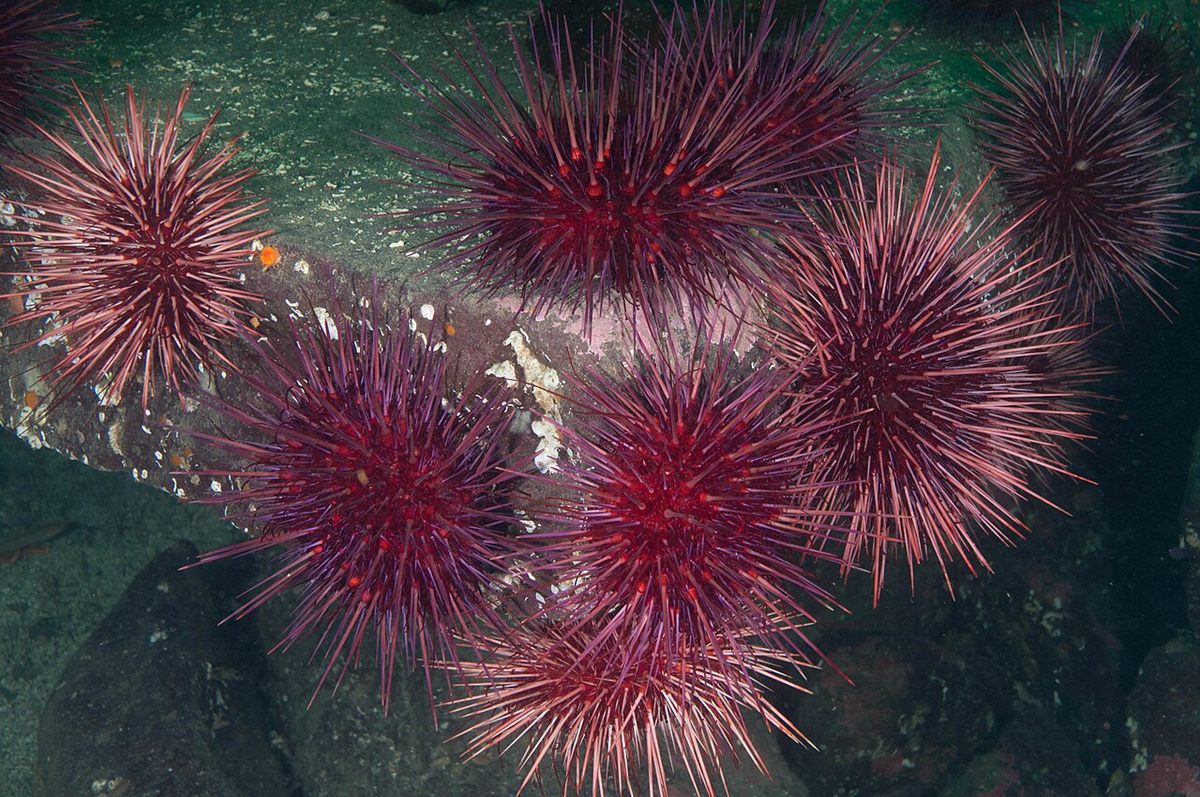
The red sea urchin (Mesocentrotus franciscanus) is the largest sea urchin, up to about 19 centimeters across, and lives in the kelp forests of the Pacific coast of North America. It can live for over a hundred years.
The red sea urchin (Mesocentrotus franciscanus) is the largest sea urchin, up to about 19 centimeters across, and lives in the kelp forests of the Pacific coast of North America. It can live for over a hundred years.
🧬 Field Guide Specimen: Open Red Sea Urchin in the CRV Science Field Guide to log the specimen, see its place among the Deuterostomia lineages in the Cladogram Explorer, and test your recall in the Red List conservation game.
Ageless Urchins
Radiocarbon dating of the skeletons of red sea urchins has suggested that some individuals live to over 100 and possibly 200 years. They show little sign of aging, with continuing growth and reproduction.
Grazers and Prey
They eat kelp and drift algae and are eaten by sea otters, sunflower stars and wolf eels. See Sea Otter and Sunflower Sea Star.
Fished for Roe
The gonads are exported to Japan as uni. Fishing began in California in the 1970s, and the fishery is managed by limits on size and areas.
Red Sea Urchin at a Glance
| Property | Value |
|---|---|
| Scientific name | Mesocentrotus franciscanus |
| Kingdom | Animalia |
| Phylum | Echinodermata |
| Class | Echinoidea |
| Order | Camarodonta |
| Family | Strongylocentrotidae |
| Field Guide group | Deuterostomia: Echinodermata (Sea Stars & Allies) |
| Diagnostic feature (Field Guide) | Large red-to-maroon globe with spines up to 8 cm long; grazes kelp along the Pacific coast and can live over 100 years. |
| IUCN Red List status | Not Evaluated (NE): no global IUCN assessment |
| Class | Echinoidea |
| Possible lifespan | Over 100 years |
See Also
- Purple Sea Urchin — a smaller Pacific urchin
- Sea Otter — a predator of urchins