Solomon Islands Skink
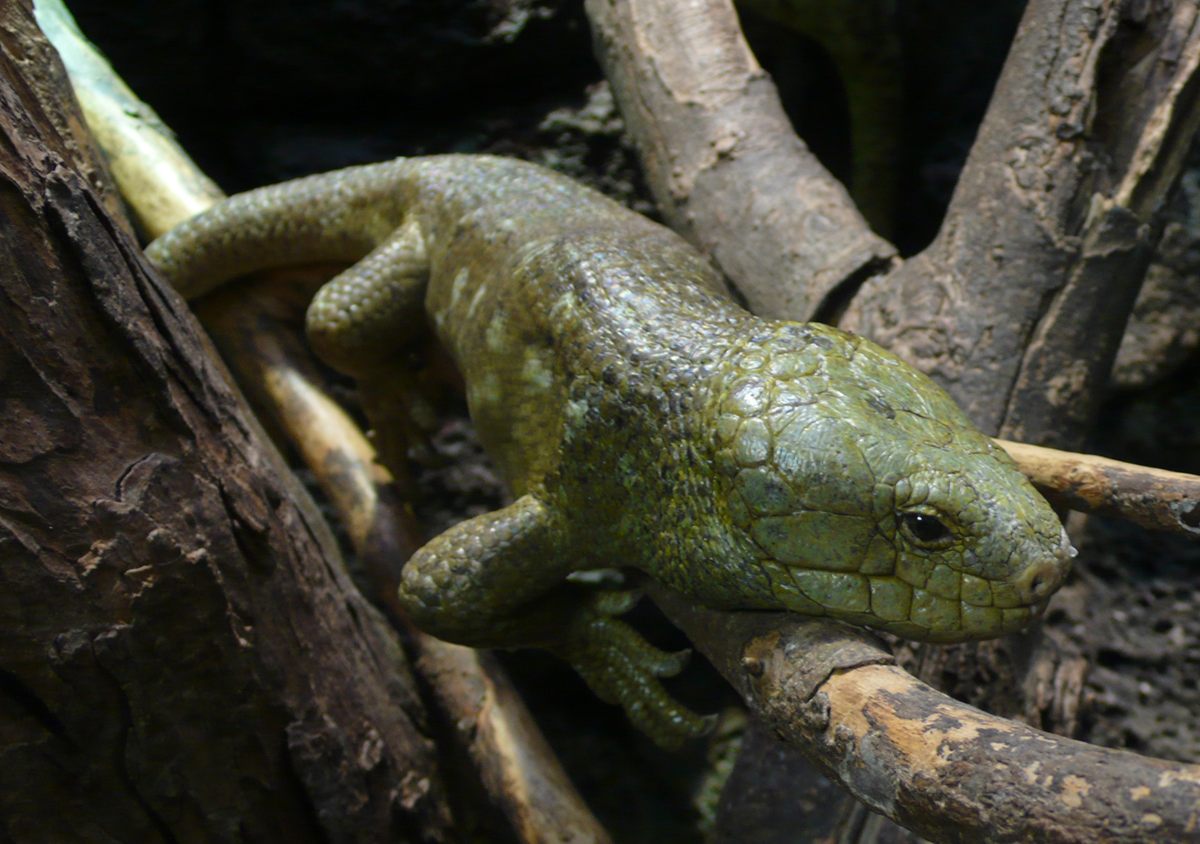
The Solomon Islands skink (Corucia zebrata) is the largest skink in the world, up to about 70 centimeters long, and lives in the trees of the Solomon Islands. Unlike most lizards, it is a herbivore with a prehensile tail.
The Solomon Islands skink (Corucia zebrata) is the largest skink in the world, up to about 70 centimeters long, and lives in the trees of the Solomon Islands. Unlike most lizards, it is a herbivore with a prehensile tail.
🧬 Field Guide Specimen: Open Solomon Islands Skink in the CRV Science Field Guide to log the specimen, see its place among the Reptilia lineages in the Cladogram Explorer, and test your recall in the Red List conservation game.
A Tree-Dwelling Vegetarian
The skink eats leaves, fruit and flowers, and has a powerful grasping tail with which it can hang from branches. Its large size and slow movement are unusual for skinks, which are typically small, fast ground dwellers.
Family Groups
Most lizards live alone, but these skinks form family groups that share a tree hollow. Females give birth to a single large baby, and adults often care for it.
An Island Endemic
Logging and hunting of the skink for food and the pet trade threaten some populations. It illustrates the unique reptile fauna of the Solomon Islands. See Biodiversity.
Solomon Islands Skink at a Glance
| Property | Value |
|---|---|
| Scientific name | Corucia zebrata |
| Kingdom | Animalia |
| Phylum | Chordata |
| Class | Reptilia |
| Order | Squamata |
| Family | Scincidae |
| Field Guide group | Reptilia (Reptiles) |
| Diagnostic feature (Field Guide) | Largest living member of its family at 80 cm: smooth overlapping scales, fully prehensile climbing tail, strictly herbivorous, gives live birth to a single large offspring. |
| IUCN Red List status | Near Threatened (NT), assessed 2021 |
| Family | Scincidae |
| Tail | Prehensile |
See Also
- Green Iguana — another herbivorous tree lizard
- Blue-tongued Skink — a ground-dwelling skink