Stibnite
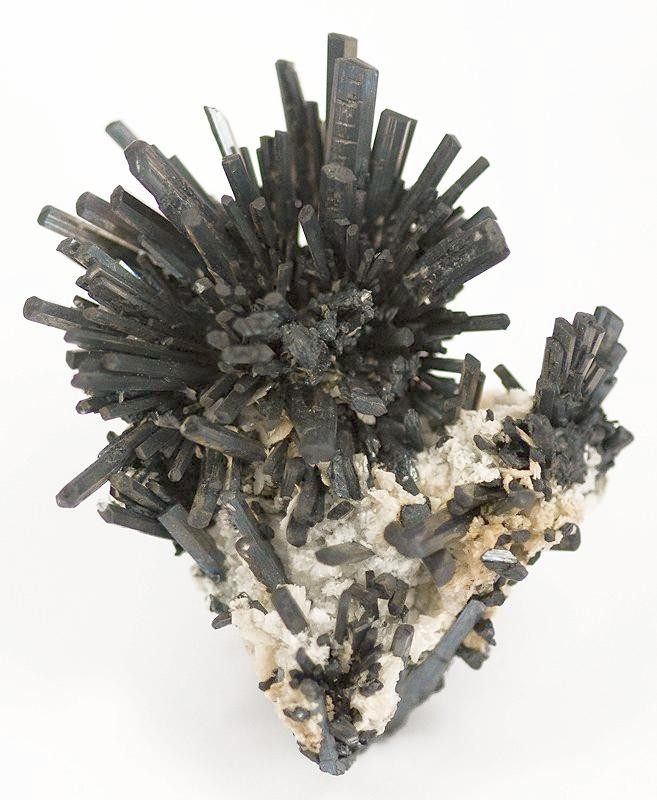
Stibnite is antimony sulfide, Sb₂S₃, which grows as long, sword-like metallic blades with a lengthwise cleavage. It is the main ore of antimony and a favorite of mineral collectors.
Stibnite is antimony sulfide, Sb₂S₃, which grows as long, sword-like metallic blades with a lengthwise cleavage. It is the main ore of antimony and a favorite of mineral collectors.
🪨 Geology Guide Specimen: Open Stibnite in the CRV Science Rock & Mineral ID Guide to log the specimen, compare it with the other 8 mineral classes of Dana / Strunz Classes, and test your eye in LithoClade.
Metallic Blades: How Do You Recognize It?
Stibnite forms slender, striated, lead-grey blades that radiate in sprays, and the blades bend slightly under pressure. Its hardness is only 2, so a fingernail scratches it, and it melts easily, even in a candle flame.
Low-Temperature Veins: Where Does It Form?
Stibnite crystallizes from relatively cool hydrothermal fluids in veins and around hot springs, sometimes with cinnabar. Spectacular specimens come from mines in Japan and China.
Uses: What Is Antimony Used For?
Antimony strengthens lead in batteries, goes into flame retardants and semiconductors and was used in antiquity in cosmetic kohl. The element is toxic in large amounts, and the old name of the mineral gave antimony its chemical symbol Sb, from the Latin stibium.
Stibnite at a Glance
| Property | Value |
|---|---|
| Type / variety | Sb₂S₃ • Orthorhombic Antimony Sulfide |
| Composition | Sb₂S₃ (71.7 wt% Antimony) |
| Geology Guide group | Minerals (8 Major Chemical Groups) |
| Mineral Group | Sulfides |
| Mohs hardness | Mohs 2 (scratched by fingernail; blades bend slightly) |
| Texture / habit | Dramatic radiating sprays of long, sword-like vertically striated metallic blades |
| Density | 4.63 g/cm³ |
| Lustre and cleavage | Mirror-bright lead-grey metallic blades with perfect lengthwise cleavage |
| Geological setting | Low-temperature hydrothermal veins and hot-spring deposits |
| Diagnostic feature (Geology Guide) | Spectacular radiating clusters of long, sword-like, vertically striated metallic silver-grey blades that are soft enough (Mohs 2) to be scratched with a fingernail and melt in a candle flame. |
| Formula | Sb₂S₃ |
| Element symbol | Sb, from Latin stibium |