Western Long-beaked Echidna
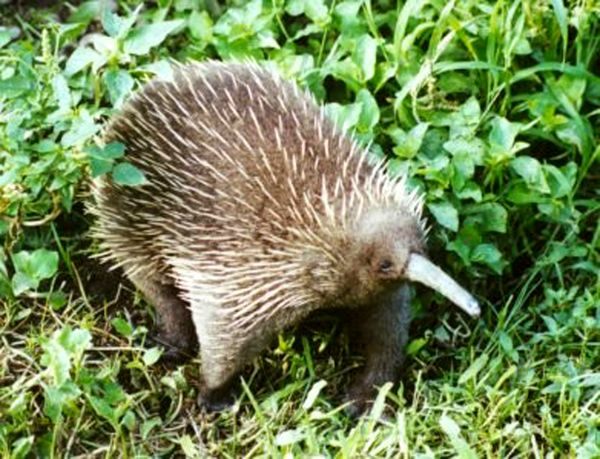
The western long-beaked echidna (Zaglossus bruijnii) is a large, spiny, egg-laying mammal of the mountain forests of New Guinea. It has a long, down-curved snout and is Critically Endangered.
The western long-beaked echidna (Zaglossus bruijnii) is a large, spiny, egg-laying mammal of the mountain forests of New Guinea. It has a long, down-curved snout and is Critically Endangered.
🧬 Field Guide Specimen: Open Western Long-beaked Echidna in the CRV Science Field Guide to log the specimen, see its place among the Evolutionary lineages in the Cladogram Explorer, and test your recall in the Red List conservation game.
A Worm Eater
Unlike the short-beaked echidna, which eats ants and termites, this species feeds on earthworms, which it pulls up with a spiny tongue. The snout is long and curved to probe into leaf litter.
Hunted and Rare
It is hunted for food in New Guinea and loses forest to logging. It was once found in Australia, where fossils exist. See Short-beaked Echidna.
Egg-Laying Mammals
With the platypus and short-beaked echidna, the long-beaked echidnas are the surviving monotremes. See Platypus.
Western Long-beaked Echidna at a Glance
| Property | Value |
|---|---|
| Scientific name | Zaglossus bruijnii |
| Kingdom | Animalia |
| Phylum | Chordata |
| Class | Mammalia |
| Order | Monotremata |
| Family | Tachyglossidae |
| Field Guide group | Evolutionary Oddities (Unique & Disputed Lineages) |
| Diagnostic feature (Field Guide) | Critically endangered New Guinea monotreme with a long, downward-curving tubular snout, short spines hidden in dense fur, and backward-Pointing keratinous hooks on its tongue for gripping earthworms. |
| IUCN Red List status | Critically Endangered (CR), assessed 2016 |
| Diet | Earthworms |
See Also
- Short-beaked Echidna — the common echidna
- Platypus — another monotreme