Giant Roundworm
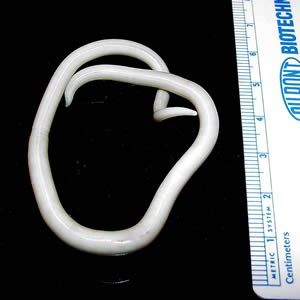
The giant roundworm (Ascaris lumbricoides) is the largest nematode parasite of the human intestine, with females growing to more than 30 centimeters. It is among the most common human parasites, infecting hundreds of millions of people.
The giant roundworm (Ascaris lumbricoides) is the largest nematode parasite of the human intestine, with females growing to more than 30 centimeters. It is among the most common human parasites, infecting hundreds of millions of people.
🧬 Field Guide Specimen: Open Giant Roundworm in the CRV Science Field Guide to log the specimen, see its place among the Ecdysozoa lineages in the Cladogram Explorer, and test your recall in the Red List conservation game.
Eggs That Wait: How Does It Spread?
A female can release around 200,000 eggs a day. The thick-shelled eggs remain infective in soil for months or years, and are swallowed from contaminated food, water or hands. Poor sanitation therefore drives transmission.
A Journey Through the Body
After hatching in the intestine, larvae burrow through the gut wall, travel via the blood to the lungs, climb the airways, are swallowed, and mature in the small intestine. Lung migration can cause cough and wheezing, and heavy worm loads can block the intestine.
Treatment
Albendazole and mebendazole are effective, and mass drug administration in schools reduces the burden. Ascaris is one of the soil-transmitted helminths, with hookworms and whipworm.
Giant Roundworm at a Glance
| Property | Value |
|---|---|
| Scientific name | Ascaris lumbricoides |
| Kingdom | Animalia |
| Phylum | Nematoda |
| Class | Chromadorea |
| Order | Ascaridida |
| Field Guide group | Ecdysozoa: Nematoda (Roundworms & Parasites) |
| Diagnostic feature (Field Guide) | Large pinkish-white intestinal parasite reaching up to 35 cm, equipped with three distinct sensory lips surrounding mouth. |
| Class | Chromadorea (Nematoda) |
| Female length | Over 30 centimeters |
See Also
- Human Whipworm — another soil-transmitted helminth
- Old World Hookworm — a hookworm