Hornfels
Hornfels is a dense, hard, fine-grained metamorphic rock formed by heat alone when an igneous intrusion bakes the rock around it. The name is German for 'horn rock,' after its tough, splintery, horn-like fracture.
Hornfels is a dense, hard, fine-grained metamorphic rock formed by heat alone when an igneous intrusion bakes the rock around it. The name is German for "horn rock," after its tough, splintery, horn-like fracture.
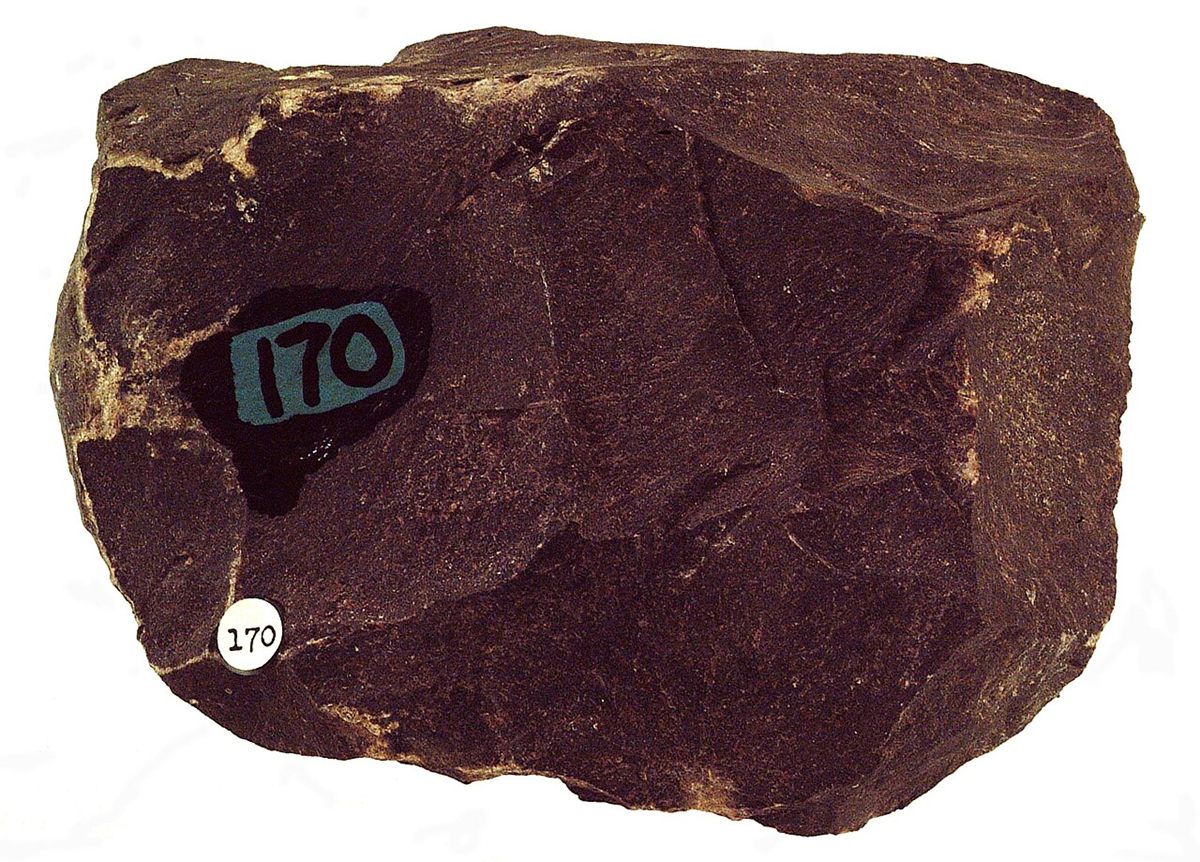
🪨 Geology Guide Specimen: Open Cordierite–Biotite Hornfels in the CRV Science Rock & Mineral ID Guide to log the specimen, compare it with the other 6 subgroups of Metamorphic, and test your eye in LithoClade.
Baked Rock: What Makes It Hornfels?
Hornfels forms at temperatures of about 500 to 750 degrees Celsius and low pressure in the inner part of a contact aureole. There is no directed stress, so the new minerals grow in random directions and the rock has no foliation or cleavage, only a flinty, interlocking texture.
Minerals: What Grows in the Heat?
A baked mudstone commonly yields biotite, cordierite, andalusite, plagioclase and quartz. Different starting rocks give different mixtures, but all are fine-grained and tough. Farther from the heat source the same rocks are only partly changed, as in spotted slate.
Toughness: What Is Hornfels Used For?
Hornfels at a Glance
| Property | Value |
|---|---|
| Type / variety | Contact-Metamorphic Granoblastic Hornfels |
| Composition | Fine Interlocking Biotite + Cordierite + Andalusite + Plagioclase + Quartz |
| Geology Guide group | Metamorphic Rocks (Foliated, Granoblastic & High-P) |
| Rock Classification | Non-Foliated (Granoblastic & Contact) |
| Mohs hardness | Mohs 6–7 |
| Texture / habit | Dense, flinty, fine equigranular mosaic with splintery/conchoidal fracture |
| Density | 2.75–2.90 g/cm³ |
| Lustre and cleavage | Dark charcoal-brown to bluish-black tough, horn-like shards |
| Geological setting | Immediate thermal baking zones (500–750 °C, low pressure) bordering magma plutons |
| Diagnostic feature (Geology Guide) | Dense, flinty, dark charcoal-brown rock that breaks into sharp, horn-like splinters instead of flat sheets because mudstone was baked at high temperature without directed tectonic stress next to an intruding pluton. |
| Name origin | German Hornfels, "horn rock" |
| Foliation | None |
See Also
- Spotted Slate — the outer, lower-grade aureole rock
- Skarn — a contact rock formed from carbonate
- Granite — a typical heat source