Obsidian
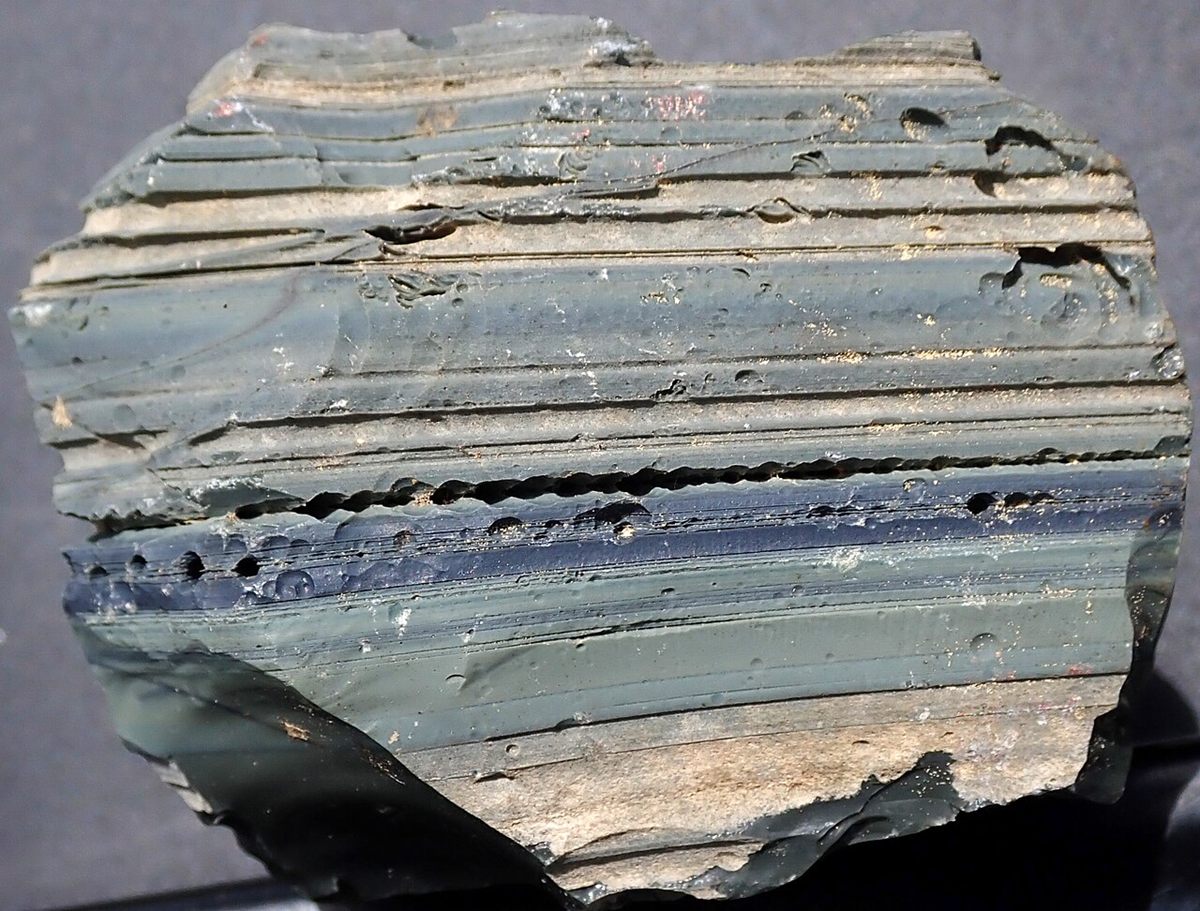
Obsidian is a natural volcanic glass, usually black and rich in silica, that forms when lava cools so fast that crystals cannot grow.
Obsidian is a natural volcanic glass, usually black and rich in silica, that forms when lava cools so fast that crystals cannot grow. It breaks along smooth, curved (conchoidal) surfaces with extremely sharp edges, and for thousands of years it was a prime material for blades and arrowheads.
🪨 Geology Guide Specimen: Open Obsidian in the CRV Science Rock & Mineral ID Guide to log the specimen, compare it with the other 7 subgroups of Igneous, and test your eye in LithoClade.
Glass, Not Crystal: What Makes Obsidian Amorphous?
When viscous, silica-rich lava is chilled quickly, as at the margin of a dome or flow, its atoms are locked in a disordered arrangement. Obsidian also holds very little water, usually under about one percent, which separates it from froth-forming pumice. Because glass is unstable over geological time, it slowly devitrifies into tiny crystals, so obsidian older than a few tens of millions of years is rare.
Color and Varieties: Why Is Obsidian Black?
Its dark color comes from iron-bearing microscopic crystals and nanoparticles, not from a different composition from pale rhyolite. Hematite gives mahogany tones, cristobalite spherulites give "snowflake" obsidian, and tiny gas bubbles or oriented inclusions create gold and rainbow sheens.
Human History: Why Was Obsidian So Valuable?
Freshly broken obsidian has edges far finer than a steel blade, so it was knapped into knives, spearpoints and mirrors on every inhabited continent. Because each flow has a distinct chemical fingerprint, archaeologists trace obsidian artifacts back to their source and map ancient trade routes, and the rate at which a fresh surface absorbs water can be used to estimate when it was cut.
Obsidian at a Glance
| Property | Value |
|---|---|
| Type / variety | Conchoidal Rhyolitic Volcanic Glass |
| Composition | 70–75% SiO₂ + Al₂O₃ + <1 wt% H₂O (trace magnetite nanoparticles) |
| Geology Guide group | Igneous Rocks (Plutonic & Volcanic) |
| Rock Classification | Felsic Volcanic & Glassy |
| Mohs hardness | Mohs 5–5.5 |
| Texture / habit | Holohyaline (100% non-crystalline amorphous) |
| Density | 2.35–2.60 g/cm³ |
| Lustre and cleavage | Vitreous lustre with razor-sharp curved conchoidal fracture |
| Geological setting | Chilled margins of water-poor silicic lava domes |
| Diagnostic feature (Geology Guide) | Jet-black, translucent natural material that breaks along curved, shell-like ripples with surgical-sharp edges, quenched so rapidly at the surface that no crystal lattice could nucleate. |
| Water content | Usually under about 1 wt% |
| Fracture | Conchoidal |
See Also
- Rhyolite — the crystalline rock with the same chemistry
- Pumice — the gas-rich glass that floats
- Volcanic Bomb — another product of quenched lava